

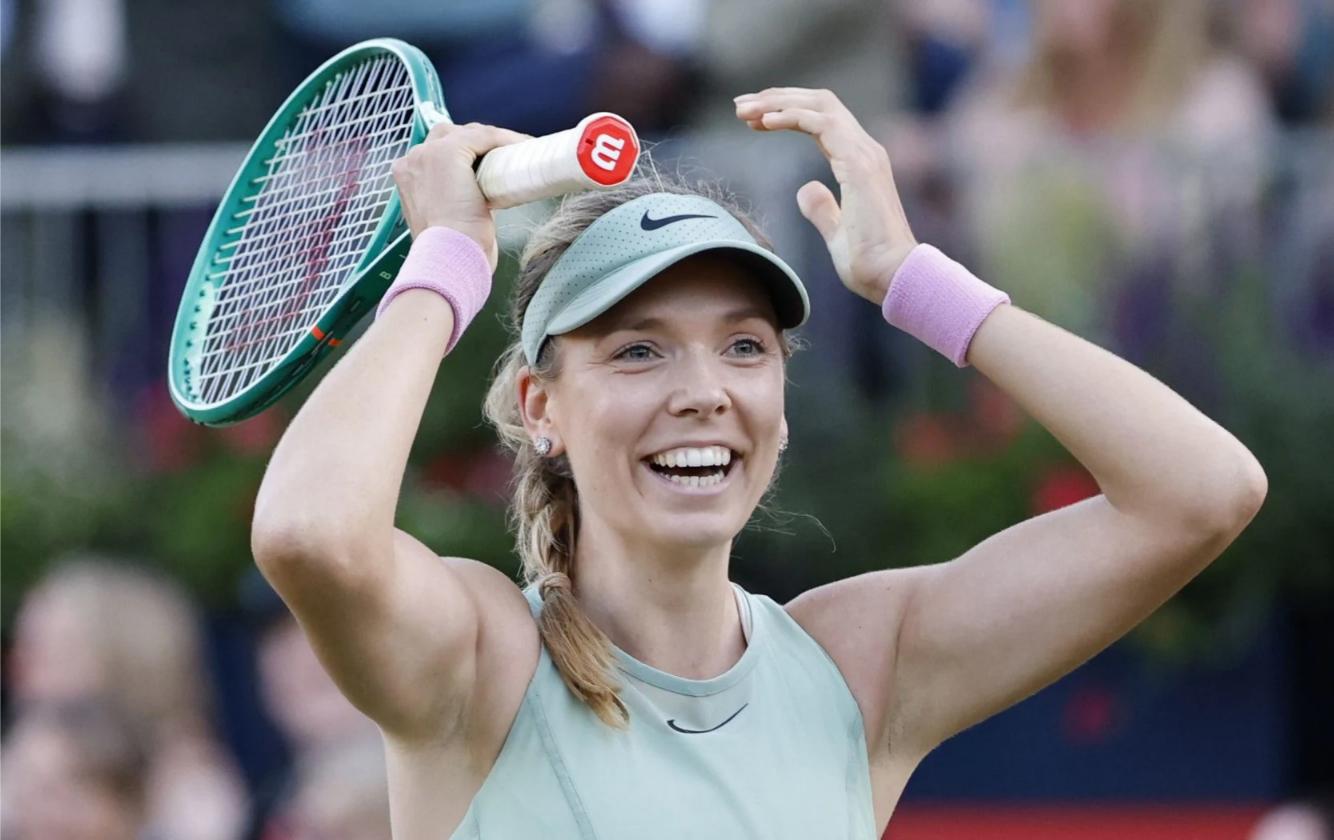
“Foxes never quit,” said Katie Boulter after she scored the best win of her career at Queen’s Club, beating world No 2 and former Wimbledon champion Elena Rybakina at her own big-hitting game.
As a fan of Leicester City – aka the Foxes – Boulter knows what it feels like to celebrate a glorious triumph against all odds. Her own upset victory wasn’t quite as unlikely as Leicester’s 2015-16 Premier League title, given that this was only a two-horse race, but it will still go down as a significant coup.
Just to underline the rarity of the feat, you have to go back nine years for the last time any British woman beat an opponent of such high standing. That instance also came on grass, when Johanna Konta eliminated second seed Simona Halep in the quarter-finals of Wimbledon.
Many of the fans on Andy Murray Arena – the main stadium at Queen’s – are not exactly of the football variety. They look more likely to be into polo or Eton fives, but they still created a wall of noise when Boulter pinged down one final sharp serve to complete her 7-5, 2-6, 6-4 victory.
“I mean, honestly, I’m not really sure what to say,” Boulter told on-court interviewer Jenny Drummond at the conclusion of the match, which came at 8.40pm. “But I really feel that this win goes towards the crowd that got me through it tonight and stayed out here.”
Later, in her press conference, she said that she had enjoyed the opportunity to avenge her 6-1, 6-1 loss to Rybakina in the third round of Wimbledon three years ago.
“I felt like I really let the occasion get to me that time,” said Boulter, “and I wanted to prove to myself and also to other people as well that I’m a better tennis player than that match.
“That one scarred me a little bit, and I wanted to come out today and prove that I can swing and I can just go for it, because I didn’t let myself go for it in the last one. I allowed her to play some of her best tennis. She’s No 2 in the world for a reason. She’s got incredible weapons. I just tried to keep it as close as possible. My plan was to commit, go for it, and use my own weapons.”
Boulter went on to explain that she felt like she had been building towards this moment “for a while”. She can certainly point to a canny coaching appointment in the shape of Michael Joyce, an experienced campaigner who previously worked with Maria Sharapova. Joyce arrived at the start of the season, after a miserable 2025 in which Boulter only once managed to win back-to-back matches at WTA Tour level, and saw her ranking slip from 24 to 112 in the process.
Joyce has already guided her to a WTA title this season, in Ostrava, and now this semi-final at Queen’s, which will bring her up against Croatia’s Donna Vekic on Saturday afternoon.
Friday’s win over Rybakina was the second match Boulter had played in the day, thanks to schedule disruption caused by Thursday’s complete washout. She had swept aside an over-matched Jacqueline Christian in only 67 minutes in her previous match, which may have given her a slight advantage when you consider that Rybakina needed almost twice as long to dispose of last year’s champion Tatjana Maria on the next-door court.
Yet Boulter’s elimination of Rybakina didn’t feel like it had much to do with stamina. The nature of these two women’s game-styles is not particularly physical, with big serves and booming forehands tending to keep most rallies below the six-shot mark.
Boulter showed enormous guts in the first set as her serve came under constant pressure, but she staved off eight break points before eventually serving the set out in a see-saw final game. It was a similar story in the decider as she slipped to 15-30 on serve in the eighth game, a scoreline which left her standing right on the precipice, before drawing back from the edge with some courageous winners up the line.
It was a day of strong performances from the British contingent at Queen’s. Although Harriet Dart lost a tight three-setter, Emma Raducanu also scored a morale-boosting win as she breezed past world No 18 Sorana Cirstea by a 6-4, 6-2 scoreline. Here was Raducanu’s first win over a top-20 player for over a year.
While this statement tells us something about the excellence of Raducanu’s performance, it also hints at the weakness of her results to date. Alarmingly, the previous highest-ranked opponent she had beaten all season was world No 57 Magdalena Frech.
Cirstea, a 36-year-old Romanian playing her final year of a consistent career, has been enjoying contrastingly strong form, and would be a top-10 player based on 2026’s events alone. Already this season, she had thumped Raducanu 6-0, 6-2 on the hard courts of Cluj-Napoca, in a match where Raducanu showed the first symptoms of the viral illness that would dog her for months to come.
In this match, however, she broke Cirstea at the first time of asking with a series of raking returns, and then defended her own serve determinedly. To be broken only once against such a high-quality opponent was a measure of a much improved performance on that crucial shot.