

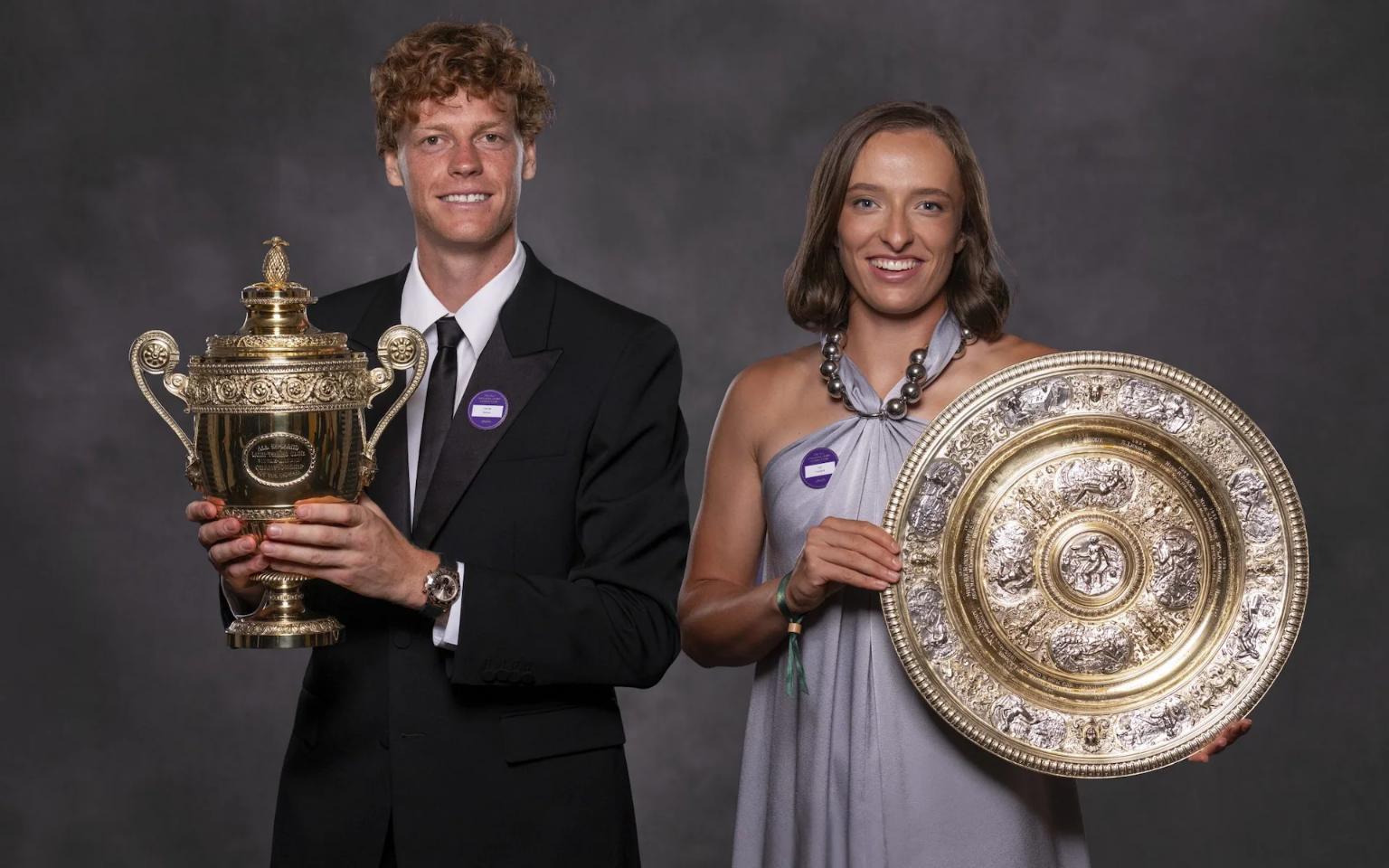
Wimbledon singles champions will collect £3.6m each after the All England Club responded to pressure from mutinous players by increasing prize money for this year’s Championships.
It remains to be seen, however, whether the players will be content with a total pot that has taken a leap from £53.5m last summer to £64.2m this year – the largest annual increase in the history of the tournament to the tune of 20 per cent.
The increase will result in first-round losers going away with £80,000 – up from last year’s £66,000 – despite not winning a single match.
Larry Scott, the negotiator chosen by the leading players, had recently spelt out their demands for an even larger increase that would have taken the total prize pot to £71.2m.
In Paris three weeks ago, some leading players, including world No 1 Aryna Sabalenka, staged a partial media boycott to highlight their complaints about the four grand slams and their supposedly inadequate prize money.
The negotiating strategy of Scott – the former Women’s Tennis Association chief executive who claims to be representing the top 10 players on both tours – focuses on the proportion of overall tournament revenues that are returned to the players, and stresses that the slams are only returning 15 per cent of their total revenues to the players overall, as against a claimed 22 per cent figure on the ATP and WTA Tours.
Projecting this year’s Wimbledon revenues at £445m, Scott had put forward his £71.2m demand on the basis it would work out at about 16 per cent of revenues. It would also have represented a 33 per cent increase on last year’s figure.
There was no immediate response to the AELTC’s announcement from Scott’s side on Wednesday. So it is too early to say whether the French Open’s media boycott – during which some leading players restricted their pre-tournament interviews to 15 minutes as a way of highlighting that 15 per cent figure – will be repeated when Wimbledon opens its gates in a fortnight’s time.
However, the players’ representatives are understood to be disappointed – on a revenue-share basis – with this latest pay award. Within minutes of the figures being released, insiders suggested that the 2026 prize-money package is only marginally higher than the French Open’s, and still stands below Wimbledon’s own peak in 2015 as a percentage of total revenue.
As ever in the administrative shambles that is professional tennis, the picture is complicated by the number of organisations involved. One of these organisations is the Professional Tennis Players’ Association (PTPA), which brought a controversial class action against the structure of the whole tour in March last year.
For the moment, it seems that most high-ranking players have rejected the more radical PTPA approach and prefer to work within the system, through Scott. It is more likely to be those who struggle to break even, the doubles specialists and lower-ranked singles players who have little to lose, who want to blow the whole game open through the legal challenge.
Only one thing really unites all the players: they want more money.
As Debbie Jevans, the All England Club’s chair, pointed out during a media briefing on Thursday: “Until recently, the ATP and WTA were their [the players’] representatives. We’ve now received letters from Larry, representing the top 10, and of course the PTPA have their class action. So I think that is something the players should absolutely be considering: of course it would always be easier to have one direct communication.”
There is frustration at the AELTC over the way this debate has unfolded. Some of the club’s senior figures believe that they could come to an agreement with the players if only they were able to negotiate without complication from intermediaries.
Above all, the AELTC rejects the whole premise of the “revenues” argument, arguing that Scott’s comparison between the majors and the WTA and ATP tours is a facile one which equates apples with pears.
While Wimbledon’s accounts are transparent, the two tours have a complicated business model in which the precise revenues of each tournament are not visible to anyone but the most senior administrators. The AELTC thus argues that Scott’s 22 per cent figure – the revenues of the tours which he claims are redistributed to the players – is highly contestable at best.
As player income soars, the knock-on effects are likely to include cutbacks at the Lawn Tennis Association (LTA). According to the contracts surrounding the two main bodies in British tennis, the LTA receives 90 per cent of Wimbledon’s annual surplus, but this payment has been declining in real terms since the early 2010s amid substantial redevelopment programmes in SW19.
As of last year, the surplus payment fell in cash terms as well, from £50m in 2024 to £48.1m in 2025. And with an extra £10.7m being forwarded into the players’ pockets this year, it is hard to see how that money can come from anywhere but the LTA’s share.
Also during Thursday’s media briefing, Jevans gave a strong indication that the AELTC would accede to any wild-card requests made by Serena Williams. As Jevans put it: “I’m sure it [the wild-card committee] won’t ignore her success at Wimbledon while making that decision.”
Williams is understood to be undecided about whether to enter the singles or ladies’ doubles events at Wimbledon, but she is unlikely to play both. On Thursday, her hopes of gaining more match time at Queen’s Club were dashed when her doubles partner Victoria Mboko – who injured herself in a fall while playing singles on Wednesday afternoon – was forced to pull out of the tournament.