

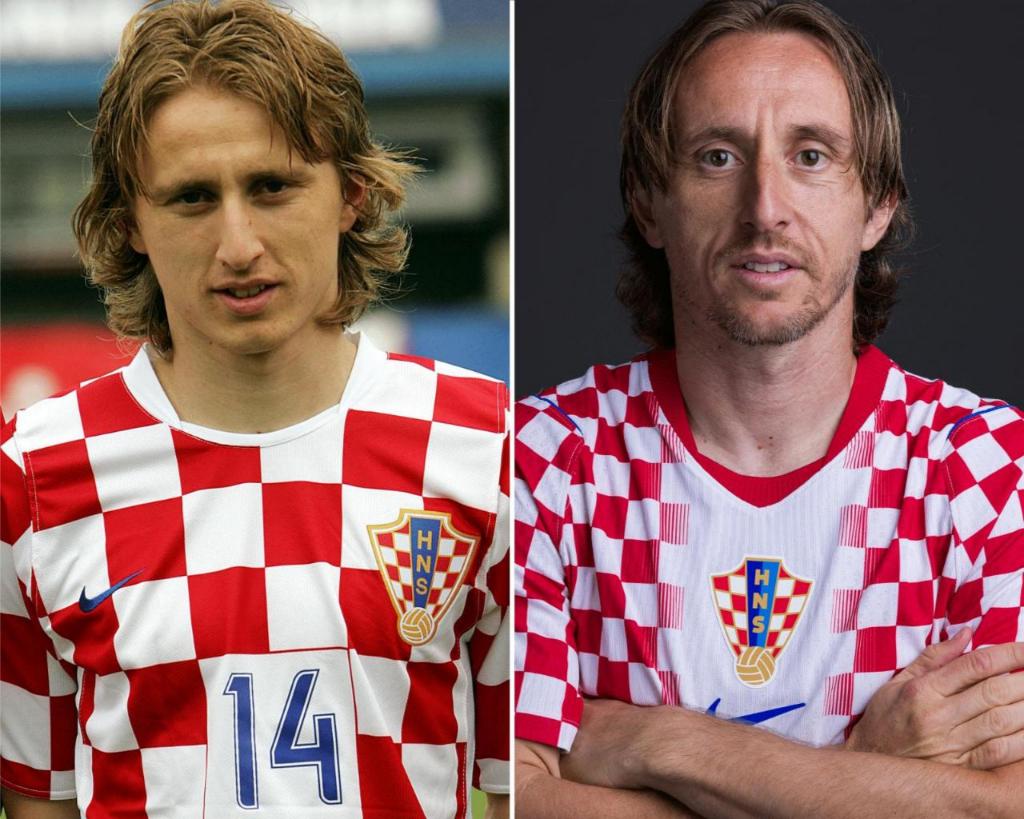
Luka Modric tends to swap shirts with an opponent after every international. It means he must need a very large wardrobe or plenty of frames. He will soon have a double century of shirts. There was, Modric said in his autobiography, only one Croatia game where he was determined not to trade the checkered kit with a member of the opposition team: against France, in 2018.
Croatia lost, but even getting there was an extraordinary achievement. Their population remains below four million, less than 0.05 of the world’s. But Modric took them to the 2018 World Cup final. He won the World Cup’s Golden Ball and then the Ballon d’Or, to follow his third consecutive Champions League with Real Madrid.
In an era of diminutive passers, Modric gained personal accolades that eluded even the Spanish technicians who won a World Cup. Modric got so close to emulating them, in part because of a rivalry that will be renewed now. Croatia face England in Dallas. Their only previous World Cup game was in Moscow, eight years ago, and in the semi-final.
Croatia trailed but Modric turned the game their way; by keeping the ball and moving it. Besides highlighting what England lacked, it also exhausted them. Croatia won in 120 minutes; they often do, given they have prevailed in five knockout ties at the last two World Cups, each after two hours of football, four after a penalty shootout as well.
Modric is the short passer who has played the long game. It is why he is in the United States this summer, playing in his fifth World Cup, set to earn his 200th cap, in his forties. He made his international debut before a teammate, defender Luka Vuskovic, was born. Vuskovic is 19, the current Borussia Dortmund coach Niko Kovac 54. Modric has played for Croatia alongside both.
He has outlasted plenty. He was Croatia’s oldest outfield player in the 2018 final but men such as Mario Mandzukic, Marcelo Brozovic and Ivan Rakitic all retired from international football long before him. Modric remains, along with Ivan Perisic and Andrej Kramaric.
Logic had suggested 2018 could be his last World Cup, then that 2022 would be. Now 2026 surely will be; there are suggestions he will retire from football after the World Cup, bowing out on a stage he has come to define. Modric has lived contrasting realities for much of his career, playing for the most famous and garlanded club of all, representing a country whose size means they forever have to overachieve and which is younger than him.
The six Champions Leagues he won with Real Madrid mean he equalled a record. A season with AC Milan meant he could follow in the footsteps of a midfielder who could have been called Croatia’s greatest player, in Zvonimir Boban. Davor Suker was a contender for that tag, too; now there is no doubt it rests with Modric.