

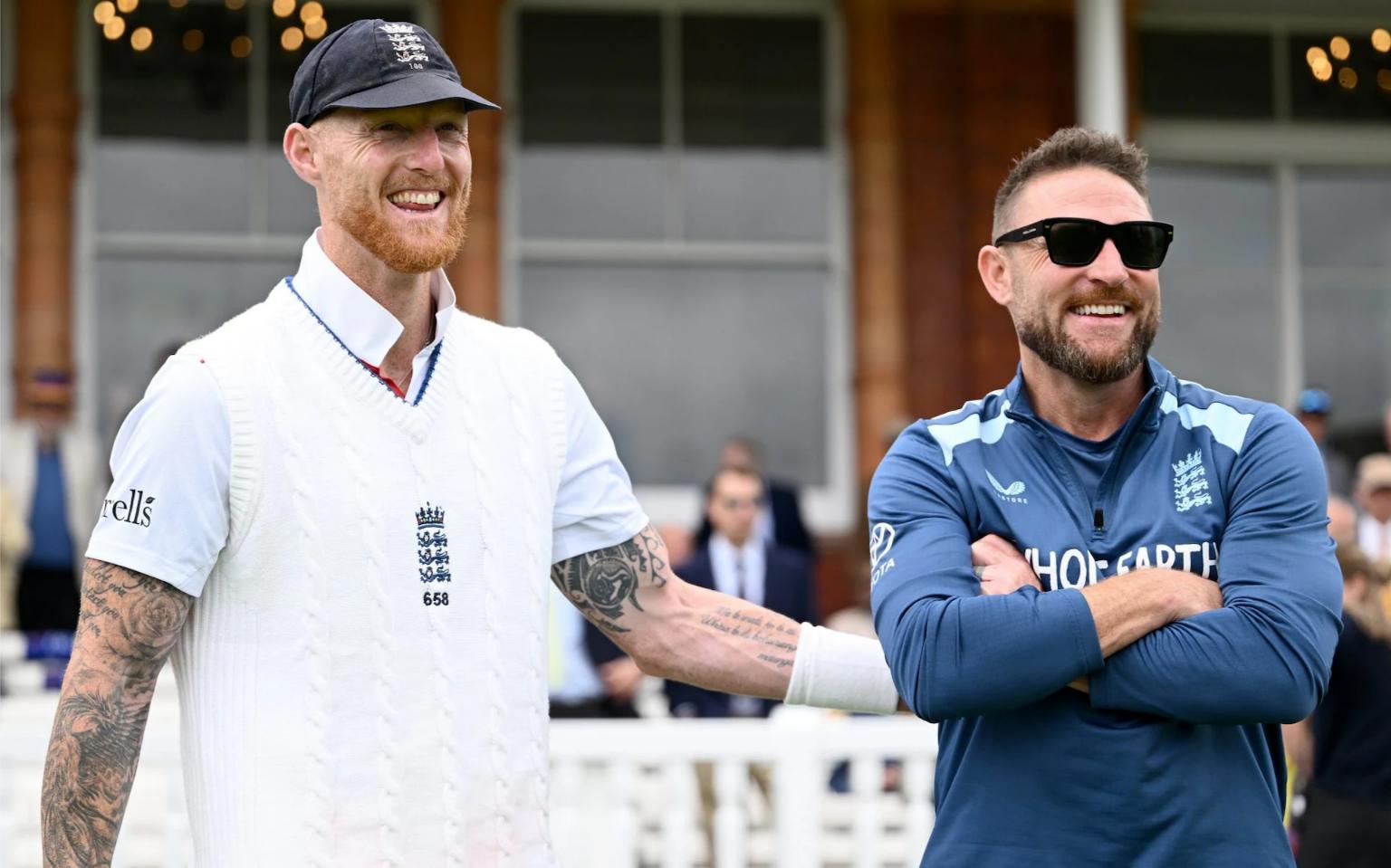
Brendon McCullum hugged his new-look coaching team on the balcony moments after the final New Zealand wicket fell to complete a good week’s work for his England team.
McCullum needed this victory and deserved it too. He went some way to re-establishing his authority over England at Lord’s and the players responded with a comprehensive 115-run win over New Zealand to begin the post-Ashes rebuild.
“The temperature’s been a bit hot of late so it’s nice to get one in the win column,” McCullum said. “In a game that was on fast-forward, there was a lot to be really pleased with. The way we were able to keep our poise, execute our plans, show some smarts when required and withstand some pressure, because you don’t win many Test matches when you’re 110 for eight in the first innings.”
A line has not quite been drawn under the Ashes, but it is a start.
England’s selection was spot on – Shoaib Bashir did not bowl a ball but nobody foresaw such excessive seam bowling conditions – and they judged conditions better than they did in Australia. When the Test match was at a tipping point on Friday after their second innings collapse of four for one, a rerun of the Perth horror show was in the air, but they rebuilt and added another 99 to put the target out of New Zealand’s reach.
Jamie Smith’s swap with Ben Stokes in the batting order paid dividends; he had a good game with bat, guiding the second-innings fightback and was assured with the gloves too. Emilio Gay justified his selection with the top score (57) in the match in the most trying of conditions for an opening batsman and Josh Tongue continued his rise with five wickets in the Test. He is England’s trump card. He could have had more in this game and in his last five Tests he has taken 18 wickets at 20. England have some depth with their seamers and it would be harsh – and send the wrong message – to drop any of them for Jofra Archer at the Oval.
McCullum swallowed his pride to recall Ollie Robinson, who responded with career-best match figures of seven for 77. Gus Atkinson wrote his name on the honours board for the sixth time in three Lord’s Tests with a second innings five for 30 as all the seamers helped themselves to the sweeties on offer.
The 150th Lord’s Test was not a classic. It lasted just 166 overs, not even two days’ full play. A wicket fell every 24.9 balls – the quickest since 1907 – as uneven bounce and extravagant seam movement off the pitch too easily breached defences. Not an over of spin was bowled for the first time in this country since 1988 and 24 out of 40 dismissals were bowled or leg before with batsmen reluctant to get forward to balls rearing up or keeping low.
Spectators went home with a 50 per cent refund on their tickets because fewer than 30 overs were bowled on Sunday and even though the tickets are covered by England and Wales Cricket Board (ECB) insurance, the loss for food and drink sales is likely to run into the millions and this, along with the reputational damage, should force MCC to accelerate plans to revamp the square. It is an urgent problem now.
For England, substance rather than style mattered after the Ashes humbling. Flip the result and an England defeat would have piled pressure on the coach and immediately reopened the debate on McCullum keeping his job.
Presumably the Oval, venue for the second Test, will be flatter and more of an examination. Not an awful lot can be learnt about players from such a quick Test match, especially the batsmen, but on the whole England were savvier than in Australia at judging the state of the game and McCullum projected an image of being in charge, more so than at any other stage in his tenure.
There was visibly more coaching going on during the practice days and the soles of the coach’s feet were not seen once resting on the balcony railings. He was on the ball. He spoke publicly before and after the match – previously he would only do so in the event of a defeat or at the end of series – and there has been a welcome policy by the ECB to encourage him to explain his thinking and communicate better.
Stokes felt the week in Loughborough before the Test series was of a huge benefit and, although unsaid, was a chance to clear the air. England were drilled and ready. Compare that to a knockabout game at Lilac Hill before the Ashes.
New Zealand helped because they continue to freeze against the Bazballers and McCullum, their former captain. They have now lost seven out of nine against his team and threw away this game, dropping Harry Brook and Gay during their half centuries. Their techniques were picked apart easily by an England attack that benefitted from having Tim Southee, recently a Black Cap player, as bowling coach.
New Zealand managed just one fifty stand – between Devon Conway and Glenn Phillips for the seventh wicket on Sunday – and a top score of 44 in the match. England found a way to win without Joe Root scoring runs, New Zealand lean on Kane Williamson in the same way and could not make up for his 0 and 18.
Stokes was a bit tetchy before the game but a win lifted his mood. His most immediate problem is his batting. It is all over the place at the moment and scrapping for form against a very good New Zealand attack is a tough place to be.
With New Zealand 55 for five overnight chasing 254, it was just a matter of time and whether MCC would have to fork out 100 per cent refunds if fewer than 15 overs were bowled. New Zealand lasted 19 overs, bowled out for 138.
It took just seven balls for Tongue to strike first, another one keeping low to remove Tom Blundell leg before.
Conway and Phillips countered with a punchy stand, partly thanks to Brook dropping Conway at slip off Tongue.
Conway held his ground waiting for the TV verdict when he skewed a catch off Stokes to Jacob Bethell at gully but once he was out, the end came quickly. The final three wickets took six overs.