

Given that the postseason — much less the NBA Finals — is more or less an expanded chess match, and how Towns’ new, expanded offensive role as a hub had fundamentally changed New York’s playoff path, attempting to throw a wrench in those plans seemed like an adequate first move for the Spurs.
Instead of keeping Wembanyama attached to Towns as he did for the bulk of their regular-season meetings, Spurs head coach Mitch Johnson opted to use one of his lengthy wings — Devin Vassell, Julian Champagnie or Keldon Johnson — on the Knicks center, freeing up Wembanyama. Such a move shouldn’t have come as a surprise, either; Vassell, for instance, was the most commonly used defender on Thunder big Chet Holmgren during the Western Conference finals.
The thinking here is simple. Similar to the previous series, allowing Wembanyama to roam and rotate resulted in the Knicks struggling in the half-court and at the rim, finishing with below-average success rates for a team that prides itself on its rate of downhill drives. Having Towns (who likes to operate around the elbows) matched up with a smaller player, in theory, should generate more isolation play, either by Towns trying to create his own shot via post-ups or encouraging another teammate (likely Brunson) to attack.
Recent playoff data suggests that Towns’ post-ups aren’t efficient and don’t generate high free-throw rates and the veteran big man finished with 18 points on 15 shots. Brunson, on the other hand, scored a game-high 30 points, but required 31 shots to get there. (More individual, slower play as opposed to the high-octane, Towns-centric attack, is the right approach.)
“He’s a tremendous player that’s skilled, picks his spots, knows his angles, shoots contested shots without being sped up,” Johnson said of Brunson. “He’s a phenomenal player. We just got to keep making him work. Thirty points on 31 shots is something that you probably want to keep making him work for those points. Probably some of the other stuff that we can probably control more than him making or missing shots.”
But as with any plan or strategy, there are holes and, against an elite Knicks team, those manifested themselves in Game 1. Moving Wembanyama away from Towns made controlling the glass a much more arduous task, with Towns snagging key offensive rebounds and either scoring on smaller players or regrouping to find a better look. New York scored 23 second-chance points, nine more than San Antonio despite grabbing five fewer overall rebounds.
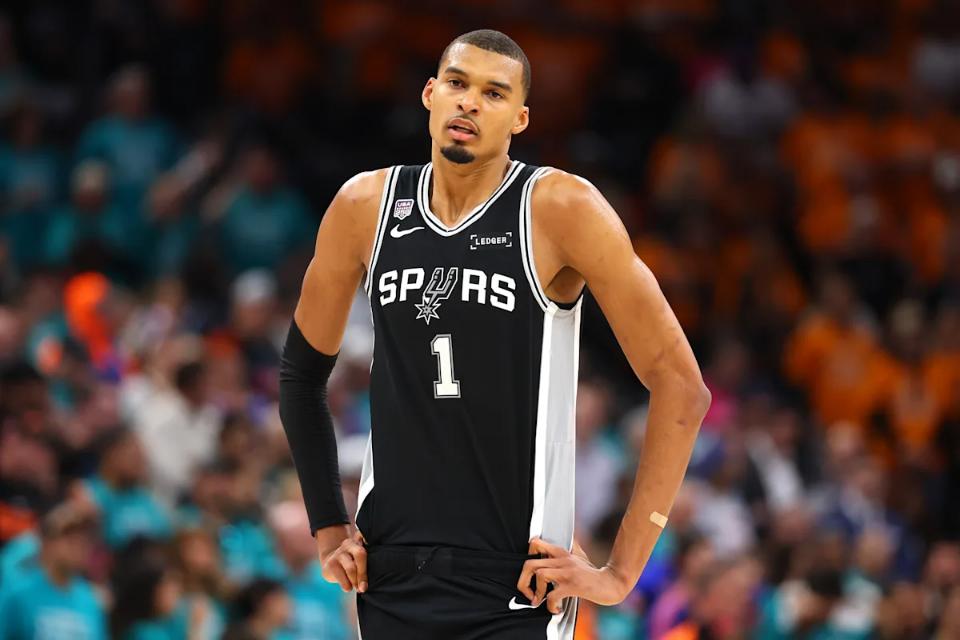
More importantly, the Spurs’ overall reliance on Wembanyama defensively, asking him to cover copious amounts of space possession after possession, ultimately appeared to drain the 22-year-old. On multiple occasions, San Antonio’s offensive chances came to a grinding halt, with the ball sluggishly moving around and ending in Wembanyama’s hands, forced to create something out of nothing.
New York did a good job of toggling different options to bump, push and dig on his touches, routinely throwing him off balance and ending in poor shots. He finished with 26 points, but shot just 6-for-21 from the field, missed seven of his nine 3s and turned the ball over six times. More time spent with his hands on his knees searching for energy and attempts to gather himself than made field goals. At the other end of the superstar spectrum, Brunson was fantastic in the final frame, scoring 13 points on an efficient 5-of-9 shooting, spearheading an emphatic 11-0 Knicks run to slam the door shut.
(San Antonio’s outside woes, missing 32 of 43 3s, are another talking point which will surely be addressed in the coming days internally. New York won’t suddenly let up on its aggressive approach and seem content, much like Oklahoma City was, with letting them fly from deep. But without Wembanyama’s inside-outside balance, the Spurs become predictable and lethargic offensively.)