

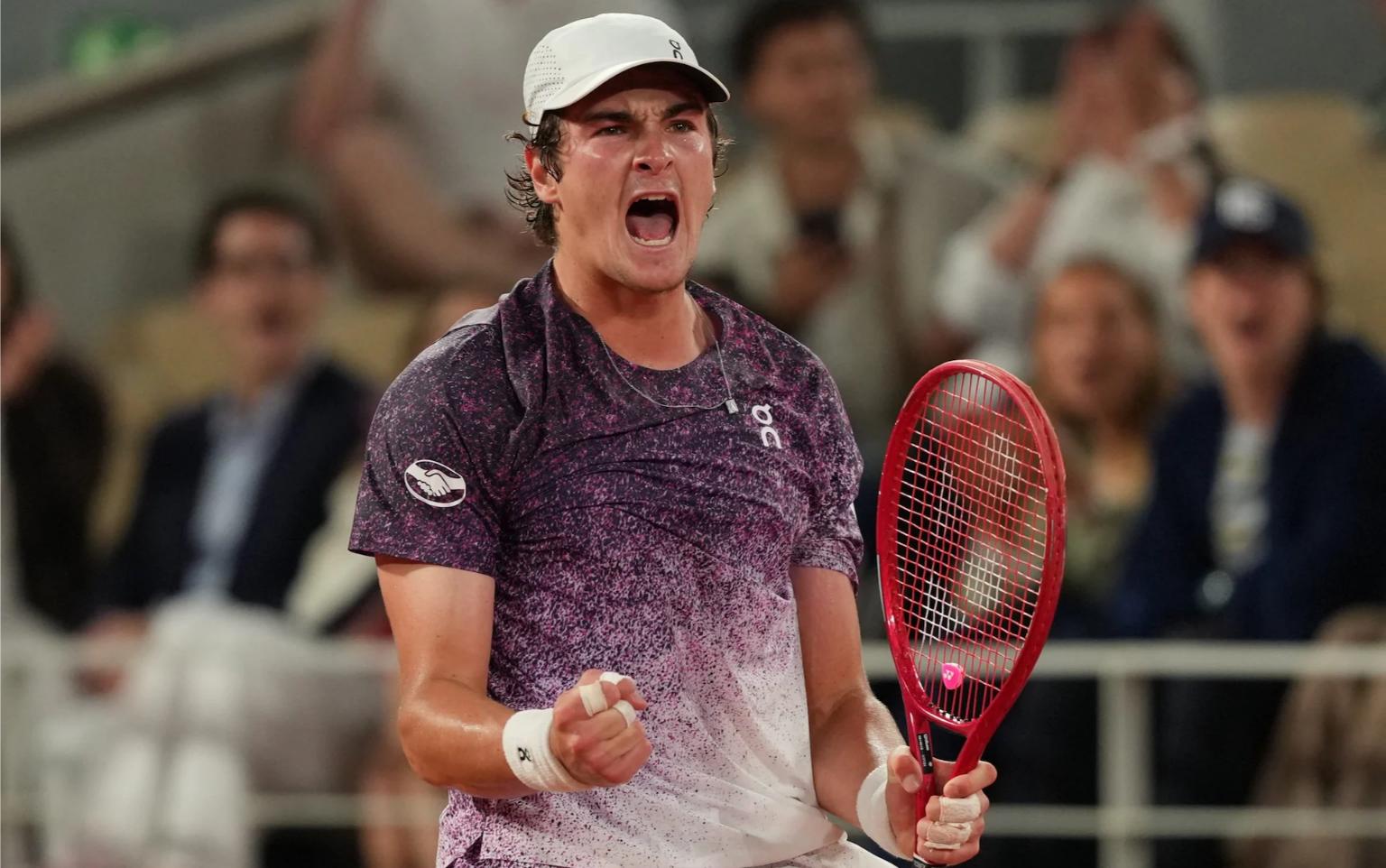
Move over Carlos Alcaraz and Jannik Sinner, a new generation are already announcing themselves on the big stage at Roland Garros in the absence of the “top two”.
No one could have predicted how the men’s draw of the French Open would unfurl in 2026. By the fourth round it was already confirmed that whoever lifted the trophy would be winning a grand slam for the first time.
The losses started before the tournament began: Alcaraz withdrew with a wrist injury, for home favourite Arthur Fils it was hip/back, for Jack Draper it was a knee, and former world No 5 Lorenzo Musetti pulled out with a leg muscle issue.
When the French Open started on May 24, the odds were skewed more in Sinner’s favour than they had been for Rafael Nadal at the height of his unprecedented dominance in Paris.
Yet at the start of the second week, Sinner’s most dangerous opponent proved to be the heat, and he crashed out in the second round. One round later and it was 19-year-old João Fonseca who proved too much for Novak Djokovic in a remarkable 4-6, 4-6, 6-3, 7-5, 7-5 comeback.
As Father Time finally caught up with 39-year-old Djokovic, who bowed out as the last player left to know what it feels like to win a grand slam, attention swiftly turned to those two decades younger. It seems 2026 is a year for the teenagers.
It has only been two years since Nadal bade farewell to the French Open, but as cries of “Vamos Rafa” echo around the courts, another fist-pumping Spaniard is delighting the crowd.
Rafael Jodar was ranked 165 at the start of 2026 and only played his first grand slam in Australia earlier this year, and, at 19 years old, has not yet filled out his 6ft 3in frame, but he certainly knows his way around a clay court.
Even his quarter-final opponent Alexander Zverev has been impressed by Jodar’s ability to attack on both the forehand and backhand sides, and he is one for the big occasion already, encouraging the crowd on a packed Court Suzanne-Lenglen.
In his 22 tour-level matches on clay, he has won 19 of them, more than Roger Federer (16), Nadal (13) and Novak Djokovic (10) at the same stage.
“I try to develop my own style, but my role model in tennis when I was younger, it was Rafael Nadal,” Jodar said after his third-round win. “Then in the last few years before I turned pro, I could say probably Carlos Alcaraz. You know, both from Spain, from the same country as me. So I think those were my two role models when I was growing up.”
Although watching Nadal was distinctly less nerve-wracking than sitting on court to watch Jodar – and you had better bring refreshments. Nadal only played three five-set matches in his Roland Garros career, but in his fourth match, Jodar has already come through two.
The noise when Fonseca strikes a forehand is almost like nothing else on the men’s tour. It goes off like a rocket and, when combined with a solid defence, proved too much for Djokovic. He has since knocked out Casper Ruud, a two-time runner-up here, in four sets, to reach the quarter-finals.
Fonseca has learnt to deal with the noise – literally and figuratively – as his matches are among the highest-attended on the tour with the number of Brazilians flocking to his matches all over the world.
He was already tipped for the top by Alcaraz last year when he knocked out Andrey Rublev in straight sets in Australia as an 18-year-old qualifier, and has consolidated that over the past 17 months.
The only question mark at the start of the year was how Fonseca would fare against the top players, and while he lost to Alcaraz and Sinner in straight sets in Miami and Indian Wells respectively, he pushed Zverev to a decider in Monte Carlo at the start of the clay swing.
Moïse Kouame might have been a relatively unknown French teenager ranked 318th in the world when he was given a wild card for the tournament. A week later, he gained a new host of fans with his showman-like appeal and impressive run to the third round.
His celebrations might have been turned into viral clicks for the social-media generation of which the 17-year-old is well and truly a part of, and he knows it, even practising his celebrations.
“It’s something I’ve always dreamed to do, get the crowd going and making a bit of a show on court,” Kouame said after his second-round win over Adolfo Daniel Vallejo, after the latter made headlines for his sexist comments towards an umpire.
“It’s not easy, that’s for sure, but I was able to draw into their energy because they were there to support me, not to stress me. But it is definitely more enjoyable to play in front of 10,000 people than 10. That’s a fact.”
There is one undeniable thing, however, even in the absence of Alcaraz and Sinner: the future is bright in men’s tennis.