

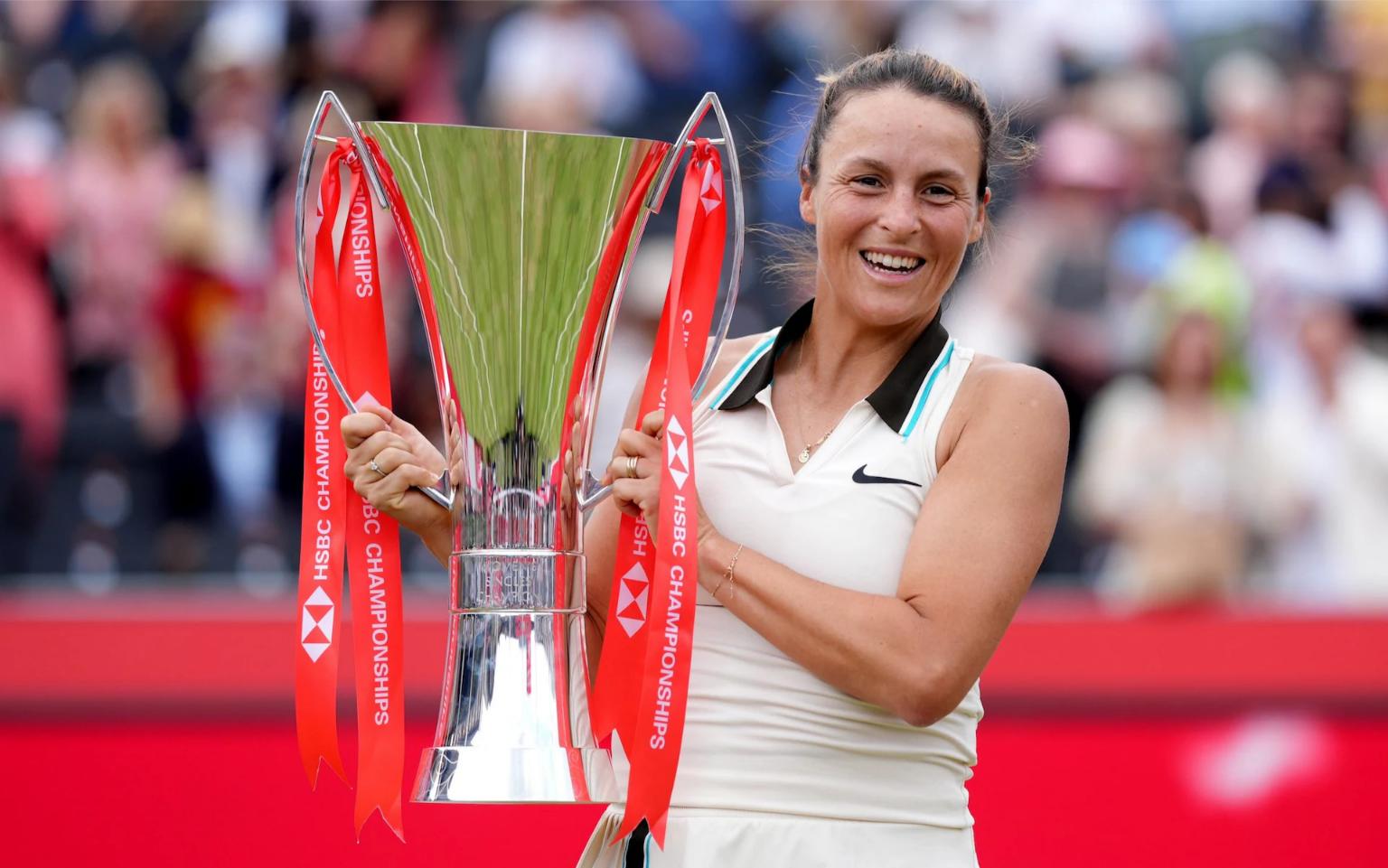
The Lawn Tennis Association is facing criticism after refusing to grant a wild card into Queen’s to last year’s champion, Germany’s Tatjana Maria.
Maria was a surprising and hugely popular winner because of the fact she was 37 and a mother of two daughters – both of whom were courtside for her victory.
Maria’s team are shocked she has been denied a wild card, with her husband and coach, Charles-Édouard Maria, saying it let down the principle of English “fair play”.
“It’s sad,” Charles-Édouard told Telegraph Sport. “After all the advertising they did for the tennis women, all the headlines last year about ‘The Queen of Queen’s’, the reality is that they are not helping us.”
The decision – which was communicated to Maria’s camp last week – is part of the LTA’s recent policy to hold back wild cards for British players only.
Yet Charles-Édouard pointed out that “it happened in the past. When Feliciano López won Queen’s, he got a wild card. And this year Serena Williams is getting a wild card in doubles”.
“Everybody on tour, and the coaches, and even people from England, are shocked that they don’t give a wild card. I understand that the priority is for the English girls, but when something happened like last year, you want your defending champion in the draw. It’s such a shame, especially coming from the English people: normally they are supposed to be really fair.”
To clarify the comparison with López, he won the men’s event at Queen’s in 2017, and was then granted a wild card into both singles and doubles two years later, even though his ranking had dropped below the cut-off point for direct entry.
To everybody’s surprise, López went on to win both events at the age of 37, earning the bigger headlines for partnering Andy Murray – then on the comeback road after a hip resurfacing operation – to the doubles title.
Maria’s victory last year felt equally unexpected, as she was watched by not only her husband but also her two daughters: 11-year-old Charlotte, who is planning to follow her into professional tennis in a couple of years’ time, and four-year-old Cecilia.
Maria delivered an extraordinary campaign as she fought through qualifying, using her slice-heavy game to defeat Amanda Anisimova in the final, and thus becoming the first woman to triumph at Queen’s Club – where the WTA had not staged an event since 1973 – since Russia’s Olga Morozova 52 years earlier.
Maria’s ranking now stands at No 54 in the world, 32 places higher than at the same stage of last year, but this is still not high enough to earn direct entry to the 500-point WTA event at Queen’s – which goes under the official title of the HSBC Championships.
Having failed to anticipate the LTA’s refusal, Maria entered the second-tier Lexus Birmingham Open, which starts this week, but she now finds herself in a quandary. Should she reach the quarter-finals in Birmingham, she will be unable to travel to Queen’s Club for the qualifying event at the end of this week. And if she cannot defend her title, her ranking will automatically plunge outside the world’s top 100.
The HSBC Championships will feature 28 players. Eighteen of these have earned their places via ranking alone, while six more will go through qualifying. The remainder are beneficiaries of four wild cards presented at the discretion of tournament organisers.
Emma Raducanu – who made a late decision not to play in Birmingham next week despite having previously intimated that she was looking for a wild card into that event – is the only British woman with a high enough ranking to play at Queen’s on her own merit.
Any other Britons – who would presumably include Katie Boulter, Fran Jones and Harriet Dart – would have to either come through qualifying (for those whose rankings are high enough) or hope for a wild card from the LTA.
Wild cards can often throw up controversy, as there are various different ways to decide who deserves to bypass the meritocracy of direct entry. Famous names – such as Serena Williams – are generally seen to enhance the commercial prospects of an event, while former champions are sometimes favoured, and national interest can also come into play.
In a statement, the LTA said: “No final decision has been made on the wild cards yet, but our approach is to prioritise British or WTA top-10 players.”