

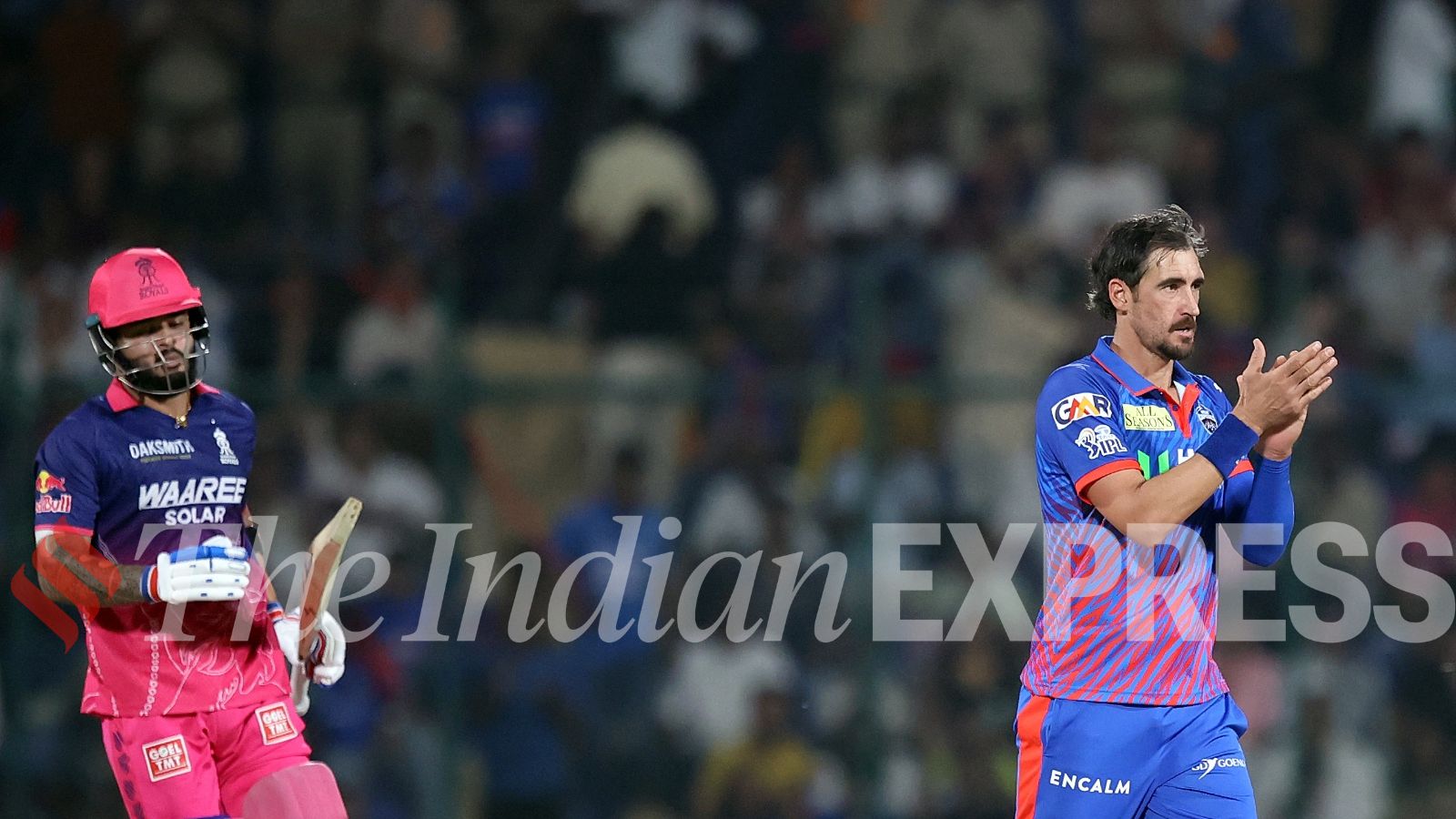
SYNOPSIS: DC wrap up a tumultuous home season with a five-wicket win that has disturbed RR’s playoff bid
A performance combining stability and execution finally arrived for the Delhi Capitals after a wretched run of five home defeats. The bowling plans were flexible in the face of an early Rajasthan Royals onslaught after opting to bowl first. Axar Patel’s men showed enough depth to orchestrate a collapse that set a manageable 194-run chase, culminating in a five-wicket win at the Arun Jaitley Stadium on Sunday.
At long last
An entire season frittered in front of the home crowd before DC found their most feasible opening combination. The right-handed pairing of Pathum Nissanka and KL Rahul didn’t provide the desired results on a consistent basis and also deprived them of proven middle-order disruptors. Taking over from the Sri Lankan, for the second time in two outings, left-handed Abishek Porel complemented Rahul without compromising on aggression.
Taking on a rearranged Rajasthan attack, Porel’s supple wrists brought a rare experience – an undisturbed 10 overs yielding 105 runs – alongside a half-century that set the pace. It allowed Delhi to eventually paper over Rahul’s relatively sluggish innings (56 off 42 balls) and a late middle-overs scare involving Tristan Stubbs and David Miller. A floating Axar Patel absorbed pressure for once and together with the hard-hitting Ashutosh Sharma (18* off five), the sixth-wicket pair lifted DC to a rare win at home with four balls to spare, keeping the suspense over their playoff qualification alive.
Three toes, a kryptonite
Even a 10-ball Vaibhav Sooryavanshi sequence involves action that lasts an entire highlights package. It began on the very first ball that brought out a glorious swivel that went soaring over the legside boundary.
Bowling brains are frozen by that inverted bat swoosh and bent back that conjures a special shot every second delivery. Attacks are limited to the rarefied margins of “magic balls”, according to his mentor Zubin Bharucha.
But even the finest bats leave frail traces somewhere in their DNA. The world could comb for weeks and months in search of a glowing kryptonite. The DC bowlers searched for that weakness on a hot evening before the trial-and-error method uncorked Sooryavanshi after 26 deliveries.
The knock was brilliant in powering Rajasthan off the blocks in their first hit in eight days. It was also momentous in capturing the first steady signs of an indiscretion tied to the end of his fiery hot bat. Even as an out-of-form Yashasvi Jaiswal could not build on the three measured boundaries in the first over, Sooryavanshi rocked back and crunched Lungi Ngidi’s quicker bumper over fine leg for a six first ball, a third such instance in 12 innings.
It was Ngidi’s second delivery that played a trick. The classic slower ball that scrambled Sooryvanshi’s timing, a toe-edge saving the pad/stumps. When the speeds were upped from Mitchell Starc at the other end, Sooryavanshi butchered the short and wide deliveries with elan. Debutant spinner Tripurana Vijay was the next to test his impulse, dragging the length back. The toe edge evaded Sameer Rizvi’s fingers as he ran backwards from mid-on. Flatter next ball, Sooryavanshi belted it into the deep mid-wicket stands – the 43rd six breaking the Indian record for most sixes in an IPL season.
When the pace wore off after the Powerplay, Sooryavanshi’s impetuosity grew with the hang time produced by his supreme backlift and back-foot game, also the signs of a great batter in Bharucha’s eyes. “Not committing to the front foot is great, but it disrupts his perception of depth against slower deliveries. That is why he struggles against 125 kph deliveries. Even when he plays a shot, he’s always leaning back. It demands special deliveries with a change in pace,” Bharucha had told The Indian Express.