

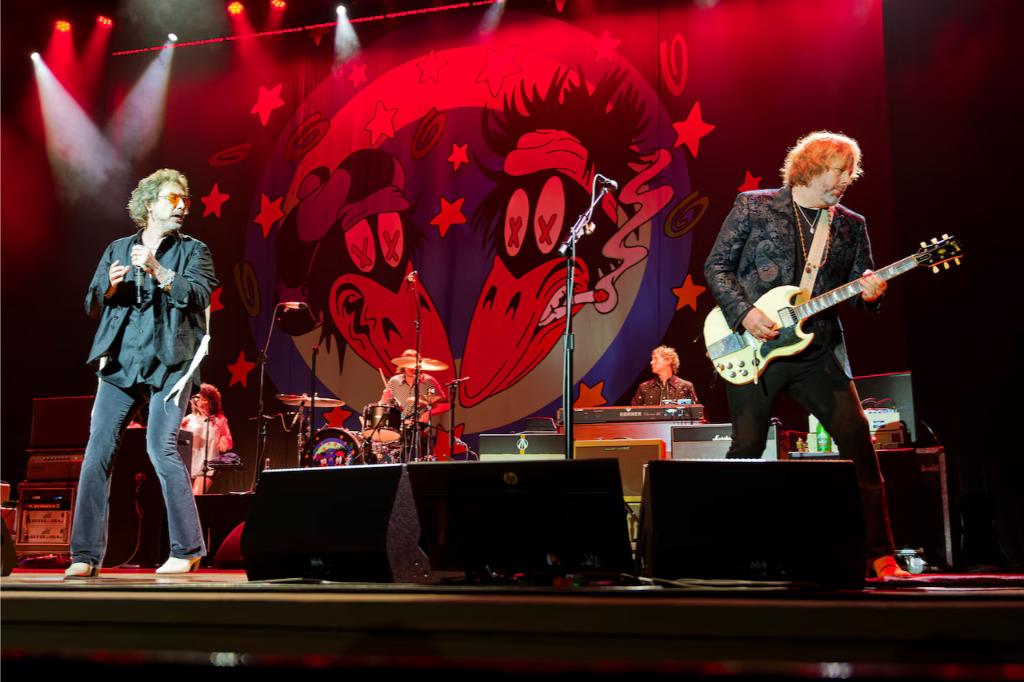
Depending on the moment, Rich Robinson’s slide guitar playing can be scorching, singing or transcendental. It’s on Black Crowes tracks like ‘90s classics “Twice as Hard,” “My Morning Song” and “Wiser Time.”
All the way to “Profane Prophecy” and “Pharmacy Chronicles,” off the Atlanta-founded rock and roll band’s strong new album, “A Pound of Feathers.”
“The slide kind of goes all over the place,” Robinson says, “and it doesn’t really have any boundaries.”
To come up with his own style on slide, he drew from guitarists like Little Feat’s Lowell George, roots virtuoso Ry Cooder, and bluesmen like Fred McDowell and Bukka White.
“The way that they would play and the way that they would use that slide,” Robinson says, “to me it sounded almost like a symphony, coming off of six strings.
Robinson’s signature trait as a guitarist though is his use of open tunings. Meaning, the guitar is tuned so even without fretting when strummed it makes a chord. It remaps and reinvents the instrument.
Robinson got the technique from the likes of Irish singer/songwriter Nick Drake and the Rolling Stones’ Keith Richards. He’s used it on hits like “Jealous Again,” “She Talks to Angles” and “Thorn in My Pride,” among many other Crowes cuts.
“I’ve always been drawn to different kinds of music,” Robinson says, “and when I first heard the sitar, the way the sitar is played, a lot of that music is talked about in micro notes. It covers more than these kinds of blocky notes.
“And so with open tunings, you can create a [sitar-like] drone. And the amazing thing about that, especially when you’re writing, even one note can really change the whole nature of a chord.”
The music business is equal parts business and music. The Black Crowes arrived in 1990 with music that rocked. It took a few decades for the band to get the biz dialed in. Led by Robinson and legendary frontman Chris Robinson, Rich’s brother, in 2026 the Crowes’ unlikely resurrection continues.
Like many long-running bands — including their British analogue Oasis, who they toured with in 2001 — the Crowes have had many members come and go. The current lineup includes bassist Muddy Dutton, keyboardist Erik Deutsch, guitarist Nico Bereciartua and drummer Cully Symington.
The famously formerly volatile band’s “Southern Hospitality Tour,” with latter-day Southern rock groups Whiskey Myers and Southall, launches May 17 in Austin, Texas. The trek comes here to Alabama on May 24, at Birmingham’s Coca-Cola Amphitheater.
These days when off the road, Rich Robinson splits time between New York and Nashville. On a recent afternoon, he called in from Los Angeles for a phone interview. Edited excerpts below.
The song “Sometimes Salvation” is a mainstay in Black Crowes setlists. It’s such a powerful, distinct song. But it’s also weird musically, as is “Remedy” [another hit from the Crowes’ 1992 chart-topping sophomore album] “Southern Harmony [and the Musical Companion]”. What do you remember about creating the music for “Sometimes Salvation”?
Rich Robinson: That song reminded me of a massive mechanical gear. In the way that the gear would shift and stop, and every time it would hit that downbeat, that stop it felt like this massive gear clicking into place. It felt like a machine.
And when you go to the release into the chorus, the movement of it, it’s almost like you dragging up a boulder up a massive hill or something. [Laughs] When it goes to that chorus, it opens wide up. And there’s such a relief and there’s such a beauty. But it’s a heavy song, you know?
And I remember I kind of was inspired a little bit by Nirvana, because “Smells Like Teen Spirit” had just come out recently. There’s that part where [Nirvana singer/guitarist Kurt Cobain] he’s singing and he’s playing a note on the guitar [in unison]. And I thought that that was really interesting and a cool approach.
You mentioned Nirvana. On the last two Black Crowes records, it’s been cool to hear you and Chris tap into your punk rock roots. Songs like “Rats and Clowns” [off 2024 LP “Happiness Bastards”]. In a recent Classic Rock magazine interview, talking about the band’s steep ascension after things brewed for a while, you said, “We went from playing in front of 50 people in Tuscaloosa to 60,000 at Donington [the U.K. music festival now called Download].” It’s been a while. But do you have memories from the Crowes’ early days playing clubs here in Alabama? Like the Varsity in Tuscaloosa, the Nick in Birmingham and Tip Top Cafe in Huntsville?
I remember playing the Varsity in Tuscaloosa, and I remember playing the Nick in Birmingham. The Nick was always such a shithole. [Laughs] But everyone played there. We used to joke the decades of beer, sweat and puke soakage on the floors probably did wonders for it.
But yeah, we played the Nick a bunch, if I remember correctly. I mean, at least four or five times. It was kind of always on … Because it’s what, two hours away from Atlanta? So we could drive there and then drive back when he played there.
I remember playing Tuscaloosa, because if I remember correctly, the venue [The Varsity], the stage was in the corner, and it was like a two-story … there was like a balcony in there.
Sure was.
So I remember playing there. But I don’t remember playing Huntsville though, for some reason. But maybe we only played it once. I want to say maybe we played a frat party or something at Auburn [University], but I can’t clearly remember because that was too long ago.
But yeah, our typical shows were we would go to Alabama and play Birmingham or Tuscaloosa. We’d go to Athens [Georgia], we’d go up to Charlotte. We would go to Columbia, South Carolina. Then we would go to Florida and play Jacksonville, at this place called Einstein A Go-Go.
Once or twice we played in Jackson, Mississippi at this place called W.C. Don’s, which was a double-wide trailer turned into a venue. W.C. Don’s stood for “We Couldn’t Decide On a Name.”
But yeah man, we kind of went all around. Greensboro, North Carolina. We would drive all the way up to Raleigh. So there was kind of a circuit that bands could do, which was great.
On recent Black Crowes shows, songs like “HorseHead” and “Oh Josephine” [from 1998 and 2008, respectively] have filtered in and out of the set. For music fans who know the early material, but came back to the band after you and Chris reunited this decade, what are some songs you’d point them to they may have missed?
Well, yeah, I mean, there’s a lot of good stuff. “Virtue and Vice” [off ’98 Crowes album “By Your Side”] is a great song. “HorseHead” ‘s a great song. “By Your Side,” I think is a great song. “Kicking My Heart Around” and “Go Faster” are great rock and roll songs.