

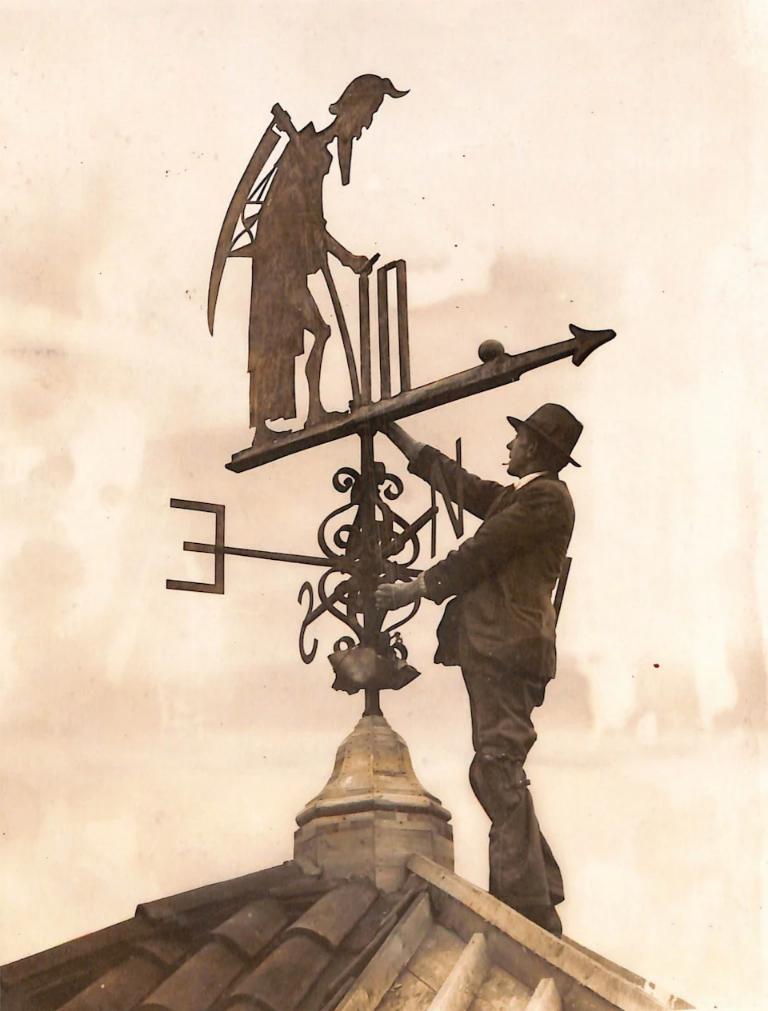
It is a long-lost photograph that provides a glimpse into another age. High on a roof stands a man, without a harness but with a cigarette pursed between his lips, putting the finishing touches on sport’s most famous weather vane, Father Time at Lord’s.
It is not known who took the photograph, or who the man is, but a date attached to the newly rediscovered photo – April 29, 1926 – means it is of archival significance to Lord’s and MCC, the proprietors of the ground, because it has provided Father Time with a birthday.
Until Alan Rees, a member of MCC’s archive team, found the photograph recently while looking through an old album, all that was known was that Father Time arrived at Lord’s in 1926 and before that year’s Ashes Test on June 26. We now know he turns 100 on Wednesday.
It has been some century. Father Time has looked over Lord’s for 132 Tests, missing just one. For context as to how central to Lord’s lore he is, this June’s match against New Zealand is the 150th Test at the ground. He has overlooked an ever-evolving Lord’s from each side of the wicket, and has become dislodged three times, requiring serious repair work. But along the way, Father Time has become one of the most recognisable images of Lord’s, but also the game more widely.
Surprisingly little is known about Father Time. He was a gift to MCC from the architect Sir Herbert Baker, who had designed the new Lord’s Grand Stand. Father Time was not in Baker’s designs for the stand, which suggests he was a final flourish from the architect to complete the project.
“It is commonly thought to be an apology because the work on the Grand Stand was overrunning,” says Neil Robinson, head of heritage and collections at MCC. “It was open for the Test in 1926, but I don’t think all of the internal fitting out had been fully completed. It is thought to be an apology, and an acknowledgement of the time factor in construction projects.”
In addition, there is even a suggestion that, along with the lateness, the gift was because of the rising cost of the Grand Stand project, which was partly caused by the 1926 General Strike. Either way, it is not often that an unsolicited gift becomes quite such a central feature of a home, in this case of cricket.
As the photo shows, Father Time is big. While the whole weather vane is 6ft 6in tall, Father Time himself is 5ft 4in tall. The design places the mythical Father Time, the idea of which dates to ancient Greece, within the game, as his right hand holds a bail next to the stumps. There is debate, however, over whether Father Time is placing the bail on the stumps to start the day, or taking it off to call time.
“There’s nothing documented about its manufacture or design, nothing to document Baker’s explanation and I think it’s up to everyone to make their own interpretation,” says Robinson.
His view, which I share, is that the bail is being removed at the close of play. The great EW Swanton, once of this parish, saw it differently.
“There’s nothing to support it, apart from my own judgment,” Robinson says. “You could argue it was all about lateness, and the end of something, i.e. the building work. That’s the most logical way of looking at it in my own mind, but Jim Swanton saw it the other way. He was always an optimistic viewer, looking forward to a day’s play.”
Baker was a vaunted architect, most celebrated for his work in South Africa and India, but was a hugely influential figure in the look of Lord’s. Between the wars, he was effectively MCC’s tenured architect. He designed the Grace Gates and Harris Garden, as well as the Grand Stand.
Baker was born and lived in Cobham, Kent, the same village as Ivo Bligh and his Australian wife Florence, and home of the Ashes urn until 1928. In Lord Harris, another man of Kent, Baker had a big proponent, perhaps explaining the regular flow of work from MCC to his firm. After Thomas Verity, who designed the Pavilion, which opened in 1890, Baker is surely most responsible for the design that makes Lord’s unique.
Father Time lived on top of the Grand Stand until 1996, when it was replaced by a new Grand Stand. The weather vane, along with the scorers’ box, moved to a new location on the opposite side of the ground, between the Mound and Tavern Stands. Given there is a clock there too, it is a highly practical corner of the ground, telling spectators the time, wind direction, and score.
Robinson jokes that Father Time has had a “chequered existence”, and has been victim of “three major incidents”. The first was during the Second World War. While Lord’s was not badly damaged by direct strikes from German bombs, they did land close by, with flats near Lord’s and a synagogue opposite the Grace Gates among the sites affected.
Father Time, though, was damaged by a defence mechanism. Barrage balloons, a blimp suspended a few hundred feet up, were stationed on the Nursery Ground. One came loose from its moorings, drifting off towards the Grand Stand. Its cabling struck Father Time, dislodging him, and depositing him into the seating at the front of the stand. The damage was not repaired until after the war.
The next round of damage was more serious. In 1992, a lightning strike caused severe damage to the hand holding the bail. It was professionally restored and, on his way back to Lord’s, paid a visit to the Blue Peter studio, where he appeared on an episode with John Leslie. Robinson’s predecessor, Glenys Williams, joined Father Time there.
The most recent mishap was in March 2015, when a severe gale almost snapped the whole object off at the ankle, and caused damage to the arm again.
“It was lying at a virtually horizontal position from the base of the shin upwards,” says Robinson, who was rushed in front of Sky Sports News’ cameras soon after arriving at work that day.
“I’d had no preparation and no idea how bad the damage was really,” he smiles. “I came up with some guff about how with every sporting injury there needs to be a period of assessment. I spoke about Father Time as if he was a cricketer, who might not be fit for the next Test match. One of those jokes that got a bit of traction, and Sky ended up doing a skit, and we did a video of one of our physios doing a mock medical assessment.”