

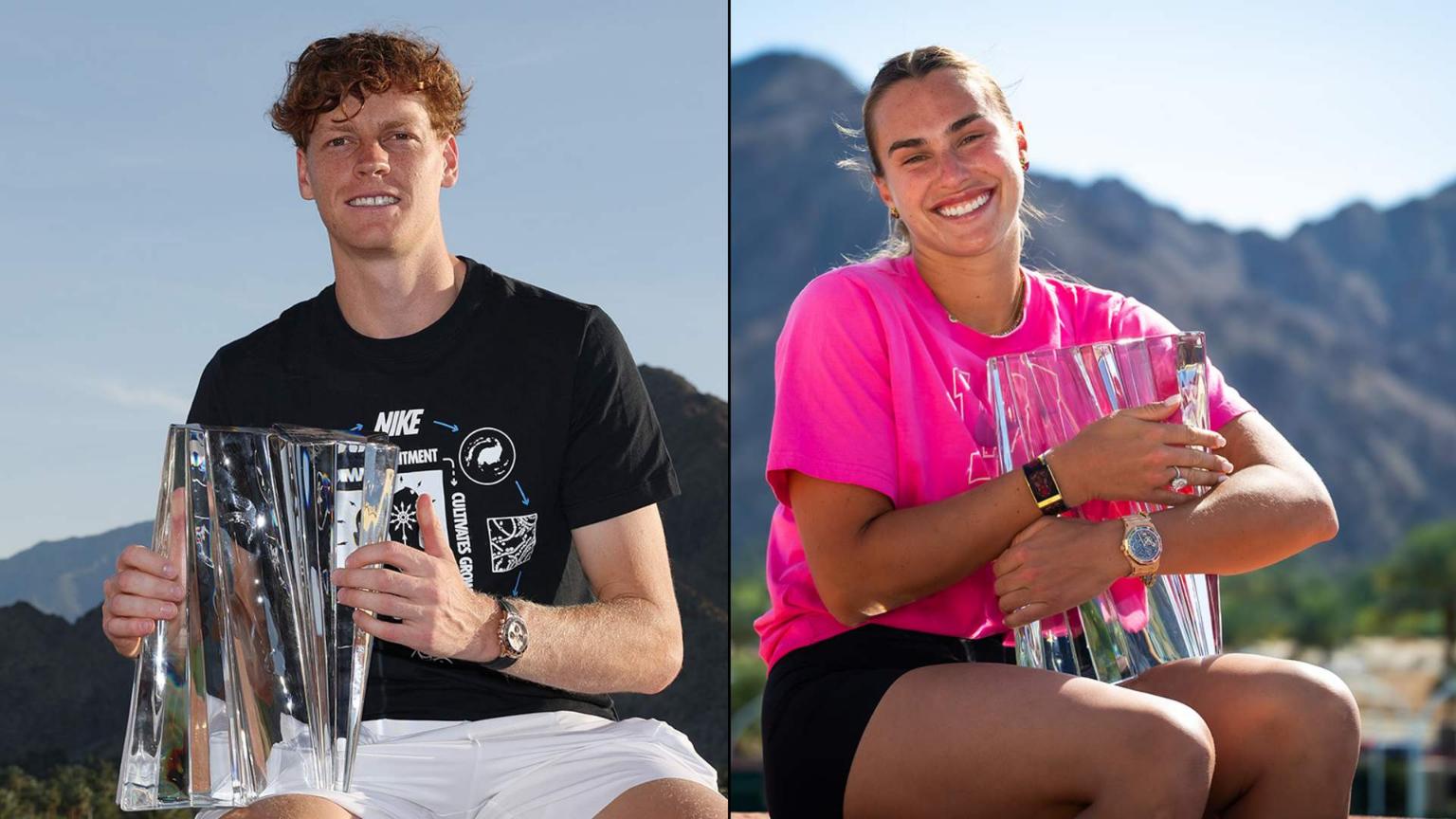
You can’t say that Aryna Sabalenka and Jannik Sinner were desperate, exactly, to win titles in Indian Wells.
Sabalenka has been No. 1 in the world for 81 weeks, and at the moment there’s no one within 2,500 ranking points of her. Sinner has been ranked either No. 1 or 2 every week since the middle of 2024; the player one spot below him, Novak Djokovic, has half as many points as he does.
The trouble with those lofty positions, though, is that every loss is magnified, and every error scrutinized for signs of vulnerability and decline. Sinner and Sabalenka each recently suffered a tough and surprising defeat at the Australian Open. She lost to Elena Rybakina in a three-set final, while he lost to Djokovic in a five-set semi.
Neither loss happened in a vacuum, either. Sabalenka’s was the latest of many final-round collapses that have plagued her and kept her from racking up the number of majors you would expect from a long-time No. 1. In Sinner’s case, he barely survived cramping in the heat in an early-round match, and he had to sit by and watch as Carlos Alcaraz won his second straight Grand Slam in Melbourne. Neither Sinner nor Sabalenka had won a title since their Aussie defeats.
More strange was the fact that nether of them had won in Indian Wells. They’ve been the premier hard-court players of this decade, but it has been their rivals, Alcaraz and Iga Swiatek—both of whom are natural clay-courters—who have thrived in the desert, winning two titles each. Whether it was the slow courts or the extreme conditions, this was the rare Masters 1000 that they couldn’t master.
But Indian Wells is a tough place to dislike, even if you don’t win there. When the tournament started, Sabalenka said she was “super happy to be back in Tennis Paradise, it’s super beautiful.” Sinner agreed that it’s a “special place,” and said his “preparation is going really well.”
Both were even happier with the surface they found there. It was faster than in the past, which suited their strike-first styles and heavy ground strokes; no longer did their topspin sit up so much after the bounce. Each made it to the final without dropping a set, and neither sounded as if they’d be satisfied with anything other than a victory.
“I want to make sure that I get it, I get the trophy,” Sabalenka said. “You know, I’m so done losing these big finals.”
“We tried to come here very early,” Sinner said. “I knew that this was a tournament I haven’t won, so I wanted to come here and prepare it in the best possible way, as professional as possible.”
Sabalenka would need every bit of her determination to avoid another big-final loss to Rybakina on Sunday.
She came out misfiring, went down an early break, lost the first set 6-3, and was broken again, on a wild double fault, to start the second set. Before the match, Sabalenka vowed to keep her emotions under control, but even that seemed to backfire on her. It wasn’t until she slammed her racquet after going down a set and a break that her game came to life.
From there, the match turned into a classic, and the WTA’s best of the year so far. Sabalenka and Rybakina, No. 1 and 2 in the world, traded big serves, bigger returns, and laser ground strokes for nearly three hours. Each woman found and lost and found her range, as the momentum ebbed and flowed across the net.
Sabalenka broke early in the third set, then hung onto her serve by a thread until she was finally broken at 5-4. In the next game, Rybakina saved five break points and held. In the deciding tiebreaker, the two combined for five winners.
The peak came at 5-5 in the breaker. Rybakina fired a down-the-line backhand winner to reach match point. Then Sabalenka fired a crosscourt backhand winner right back at her to save it. A missed Rybakina volley made it 7-6, and a final, unreturnable Sabalenka serve ended it. This time she could flash a look of satisfaction, rather than devastation, at her team.
“I’m super happy that in those last three points of the match, I was able to pull out really great tennis and get the win,” Sabalenka said.
“With so many finals that I’ve lost, they also teach me a lot of things that basically the game is never done till it’s done,” she added. “So if it’s a match point, you still have a chance to get back into the game.”
Sinner and Medvedev were hard-pressed to top the women. The temperature, which peaked around 97 during the men’s match, didn’t help. At various points, both looked gassed and tried to keep the points as short as possible.
Yet they still put on a hard-nosed display of toe-to-toe baseline tennis, with no breaks of serve, for two hours and 24 games. Medvedev was as aggressive as he has ever been, and he matched the Italian’s pace on each wing. But it was Sinner, like Sabalenka, who raised his level to an unbeatable height in the tiebreakers.
In the first-set breaker, the two traded big serves to reach 6-6. It was then, on a regulation backhand, that Sinner suddenly let loose with an injection of pace that won him the point. “Well done,” said his impressed coach, Darren Cahill, before Sinner closed the set with a service winner.
Even more impressive was what Sinner did in the second-set tiebreaker. Appearing to cramp, he lost the first four points, and struggled just to serve the ball. A third set in the blazing heat loomed. Instead, needing the match over now, Sinner refused to miss again. He hit a return winner, a passing shot winner, a smash, and then, up 5-4, scrambled side to side until he had stolen a point that Medvedev appeared to have won. He completed his seven-point run, and his title run, with a winning forehand. All Medvedev could do was nod his respect when they met at the net.
“It feels amazing,” Sinner said. “Great achievement.”
“I felt very well prepared, so I was not having big issues with the weather and with the heat, which is very positive for me. But look, it’s all part of the process we are trying to do and becoming the best possible athlete.”
When they had to have their best, late in the tiebreakers, Sinner and Sabalenka found it. Now both of them have Indian Wells titles, and confidence-building 2026 victories. They may not have been desperate, but it has to feel good.