

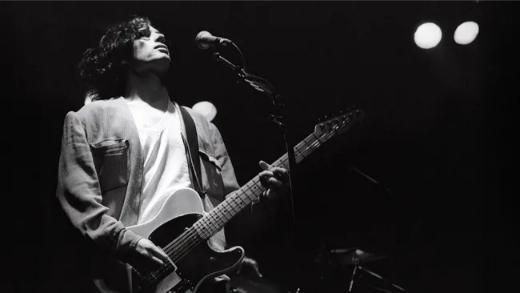
Jeff Buckley has long been renowned for his hair-raising vocal, but his guitar talents are overlooked by many.
Ella Feingold is one of the most respected rhythm players in the business – with credits including Erykah Badu, Silk Sonic, Bruno Mars, Jay-Z, Frank Ocean and many more.
She’s also someone who has a truly deep fandom of Buckley and – thanks to her background as an arranger/orchestrator, and friendships with many of his peers – a true understanding of him as a musician and person.
Knowing the kind of person Jeff was, I doubt he would have cared much for a Rock and Roll Hall of Fame nomination. That kind of spotlight seemed to make him shrink a little – he wore praise like an ill-fitting coat. And yet, as a fan and a musician, I feel a quiet joy watching the world finally gather around him.
The documentary It’s Never Over, his music rising again on the Billboard charts, the song Lover, You Should’ve Come Over finding new life on TikTok, and now this nomination – it feels like people are waking from a long sleep and whispering, ‘Oh. There he is.’
What drew me to Jeff most was not just his voice, but the way he absorbed other artists – not as a mimic, not as an impersonator, but as a vessel. Through him you could hear Nina Simone, Judy Garland, Nusrat Fateh Ali Khan, and Robert Plant – not as impressions, but as spirits moving through him. He didn’t memorize them; he communed with them. He distilled something essential and then reshaped it into something unmistakably his own.
I feel close to him in that way. I’ve done the same with guitarists – fallen deep into their catalogs, lived inside their phrasing, studied every inflection – and then tried to emerge carrying those influences without being consumed by them. I recognize Jeff as a student of music, endlessly curious, reverent before sound itself.
His guitar voice was singular. You can trace echoes of Robin Guthrie – hence the Alesis Quadraverb, that cavernous, dream-drenched shimmer – and of Johnny Marr, in the melodic interplay of open strings ringing through fretted notes. When he was young, he loved Rush, Yes, and King Crimson – and you can feel that architecture in his sense of scale and drama. Yet when it all converges, it does not sound like a collage. It sounds like Jeff.
Imagine him stepping onto his first tour in 1994. In an era thick with grunge pedals and scuffed distortion, he arrives with a rack-mounted shimmer more celestial than gritty. The Quadraverb was not the language of his peers – but it was his. That blooming, reverberated expanse became as much a part of his identity as his voice.
Listen to Dream Brother and you feel the trance of Qawwali music, something incantatory and ancient. Then he turns and sings Hallelujah, inhabiting the quiet ache of the singer-songwriter tradition. Elsewhere – The Sky Is a Landfill, Vancouver – there’s grease and bite, a looser, post-punk shadow flickering at the edges. He refused containment.