

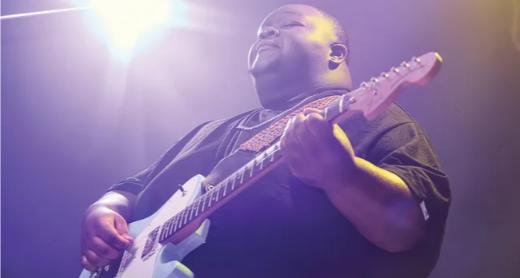
He may only be approaching his late-20s, but at this stage of his career, blues singer-guitarist Christone ‘Kingfish’ Ingram can no longer say he’s the new kid on the block.
He’s a Grammy-winning artist who has earned the respect of his elders and peers, with his own Kingfish Telecaster Deluxe signature through a Fender Twin, along with invites to open for artists such as The Rolling Stones, Slash and Joe Bonamassa.
Last year saw the release of his third studio album, Hard Road, which features more nuance than ever before. It’s still a blues-rock record all in all, although Ingram has broadened his horizons by moving away from heavier tones in favour of cleaner and more soulful musings.
There’s more variety to the new music than anything you’ve recorded to date.
I wanted to focus on my artistic growth; that’s all I wanted to showcase on this record. My sound hasn’t changed too much, there are still some heavy tones in places, but I did think about my sound just before we started recording.
Certain songs needed a cleaner approach, so I decided to experiment and try out some things I haven’t done in the past.
I’ll explore new directions and navigate through whatever might be happening in my personal life. This album is like a documentation of my last four years. Some of the songs were written during the sessions for [Grammy-winning previous studio album] 662 but ended up conveying how I’ve felt in the time since, too.
I’ve also been working with a few external writers. There was one song I did all by myself [Clearly], where I was in the studio alone one night. I’m proud of how it all came out.
I used my signature Tele a lot, as well as an ES-335 on some songs. The semi-hollow wasn’t mine; it was an early 2000s model that the studio had. The album was mainly recorded with my live rig, so you can probably hear pedals like my Marshall ShredMaster on there. The main amp was a regular Fender Twin. I even plugged straight into the board for some of the rhythms. That was about it.
The opening track, Truth, benefits from some funky single-note lines, a screaming wah solo and some of your catchiest vocals to date.
That was all done on a Strat – it was the purple Custom Shop one seen on the cover of my 662 album. Singing is definitely another area I’m trying to grow in. I’ve always felt my voice is just as good as my guitar playing, so this record was about trying to push both at the same time.
Yeah! That was a fun thing to do because it was so out-of-the-box. It helped me come up with things I haven’t done before vocally. There are some cool changes in there.
I think the jazz influence comes from doing a lot of listening – and not just listening to guitar players but other instruments as well. [Pianist] Oscar Peterson is one of my favourite jazz musicians, and the same goes for [pianist] Art Tatum and [saxophonist] Charlie Parker.
Which guitar players have influenced this side of you?
People like Charlie Christian demonstrated how much you can achieve with simple bebop lines, which led to me trying to implement them into rock and blues. Josh Smith is amazing at that stuff; he’s someone who I really look up to. The way he plays is how I want to sound one day in the future because it’s a mixture of blues and fusion.
The self-penned track Clearly features some beautiful jazz voicings. It could be the jazziest song you’ve ever written.
There’s definitely some major 7s in there. I had that groove in my mind for a long time. I was struggling with it for a while, but one night in the studio, it just all came out really easily.
Nothin’ But Your Love is a ballad in Ab major. When you play on a song like that, are you thinking more in Ab major or F minor in terms of where you place your fingers?
I will be thinking more in terms of Ab major, trying to paint a picture in my mind and tell the story. I might use some swells or go for a more mellow attack. It’s the opposite to what I normally do. I’m more used to playing like that nowadays, though it wasn’t always like that because blues tends to be more minor. When you play in major, you really have to dig deep.