

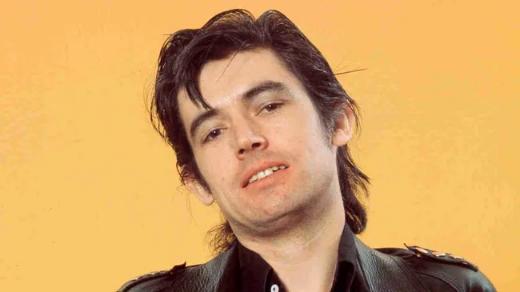
Chris Spedding is one of the great unsung heroes of British rock – a man who produced the Sex Pistols, played with everyone from Bryan Ferry to Tom Waits and turned down a chance to be a Rolling Stone. In 2015, Classic Rock looked back over the career of a man who should be much better known than he is.
Chris Spedding strolls down Denmark Street, aka Tin Pan Alley, glancing at the guitar shops that will soon vanish beneath Cross Rail, and recalls how this central London street was once the epicentre of British rock’n’roll.
“Regent Sounds Studio was here,” he says, “where the Stones and everyone else recorded. The Giaconda café was a few doors down, and that’s where all us musicians would gather. The Sex Pistols’ rehearsal room was up there, on the far corner. When I first arrived in London in the early 1960s, Denmark Street was full of music publishers and I’d come to them to get sheet music of the current hits for the dance bands that I was then playing in.”
Spedding is British rock’s unsung guitar hero. For almost 50 years he has lent his remarkable touch to hundreds – possibly thousands – of recordings. On top of his own dozen-plus solo albums, he can be found on recordings by household names (Elton John, Bryan Ferry), critics’ favourites (John Cale, Harry Nilsson) and cult heroes (Willy DeVille, Frankie Miller). He helped launch the Sex Pistols and The Cramps, turned down an offer to join the Rolling Stones and he’s even briefly been a Womble.
Yet apart from his 1975 hit Motorbikin’, this Zelig figure has never troubled the mainstream. As we walk through central London, no one appears to recognise the 70-year-old, despite his white, David Lynch quiff. Raised in Sheffield, he retains a Northern directness and is refreshingly free of affectation. This could go some way to explaining his lack of bitterness about not having had the same level of success as the likes of Beck, Clapton or Page – or their fortune.
When we’re seated in a nearby pub, Spedding explains: “Some session musicians are bitter, but I had the good luck to have my solo albums as an outlet. Anyway, I never went that route of doing big guitar solos. To me, Jeff Beck is the British rock guitarist I admire the most. He’s a virtuoso. I’m not a virtuoso. I’m a guy who comes up with short, sharp, tasty licks.”
Spedding was born Peter Robinson in Stavely, Derbyshire in 1944. He never met his father, an RAF pilot killed towards the end of WW2, and his mother had him adopted. His new parents, Jack and Muriel Spedding, renamed him and raised him in Sheffield and Birmingham. They were a musical family, with Chris singing in the church choir and studying violin.
The arrival of skiffle in 1956 quickly found the youth enthralled with rock’n’roll. A natural guitarist, he moved to London in 1961 and began playing in dance bands that performed the popular hits of the day. These large dance bands, now extinct but once a staple of British light entertainment, provided Spedding with a thorough musical training and were, he says, an incubator for many session musicians.
And it was as a session musician that Spedding would first make his mark: in 1965 he got studio work playing with Dusty Springfield and Paul Jones. In 1967, Pete Brown, the poet best known for writing lyrics to several of Cream’s songs, asked Spedding to join his band Battered Ornaments. The band recorded two albums, ousting Brown during sessions for the second, and Spedding suddenly found himself as the vocalist as well as the guitarist. His first concert as a frontman found Battered Ornaments opening for the Rolling Stones at their August 1969 Hyde Park concert.
Jack Bruce then hired him to play on his debut solo album Songs For A Tailor. Spedding also joined Nucleus, a pioneering jazz-rock band, and this launched his solo career.