

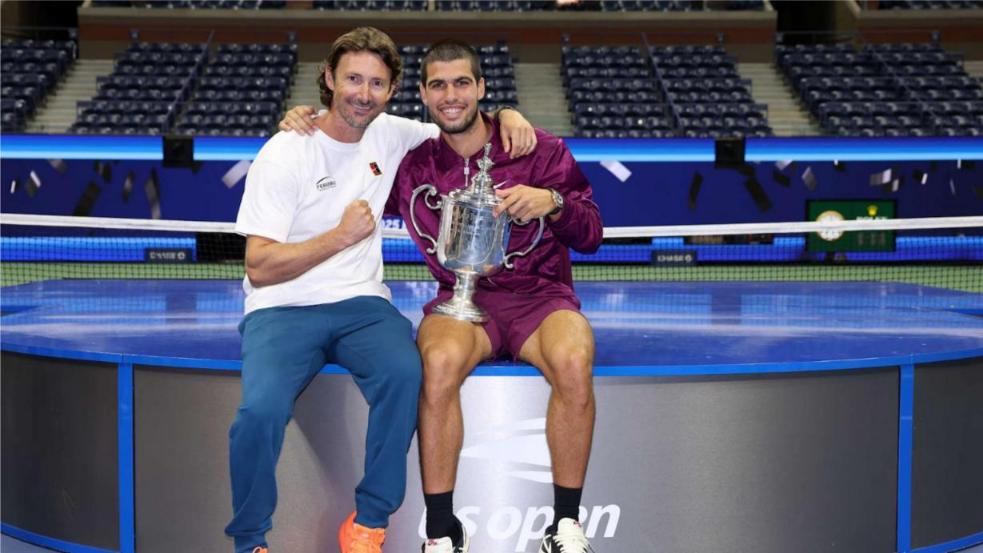
Very few great players have followed that ancient piece of advice to, “Quit while you’re on top.” But they appear to be all-in on a counter-intuitive adage: “Fire your coach while you’re on top.”
The latest pro to embrace the new dictum is Carlos Alcaraz, who announced on social media on Wednesday that he has split with his coach of seven years, Juan Carlos Ferrero. Alcaraz, or whomever is crafting his social media, wrote: “We have reached the top, and I think that if our sporting paths have to separate it should be from there, from the place we always worked for and aspired to reach.”
That was a dignified way to put it, but it still left pundits shocked and fans weeping and gnashing their teeth. Among other things, Ferrero had just days earlier been named the ATP’s 2025 Coach of the Year. There is something weird about this development. It’s like a race-car driver firing his crew chief after winning the biggest race of the year, or a person dumping a spouse upon returning from an idyllic vacation mostly spent laying around mooning over each other.
In a social media post of his own, the jilted coach wrote, “[This day is] one of those when it’s hard to find the right words. Saying goodbye is never easy, especially when there are so many shared experiences behind it. We have worked hard, grown together, and shared unforgettable moments.”
That also was a dignified way to put things but there were different feelings simmering beneath Ferrero’s flowery words. After making the obligatory prediction of further success for Alcaraz, Ferrero couldn’t help but add, “I wish I could have continued.”
Great tennis players are celebrities now. Their kind does mystifying things, speaks in a kind of code invented by a Praetorian Guard of managers, publicists and spin doctors. Social media has put the players and their associates in control of their own narratives. Luckily for us, those are usually transparent. Has any coaching relationship ever ended like a bad romance, without lavish expressions of mutual admiration and fawning gratitude? Doesn’t a coach ever get fired for asking for a big raise, failing to hit goals, philosophical differences, chronic halitosis, or ignoring boundaries.