

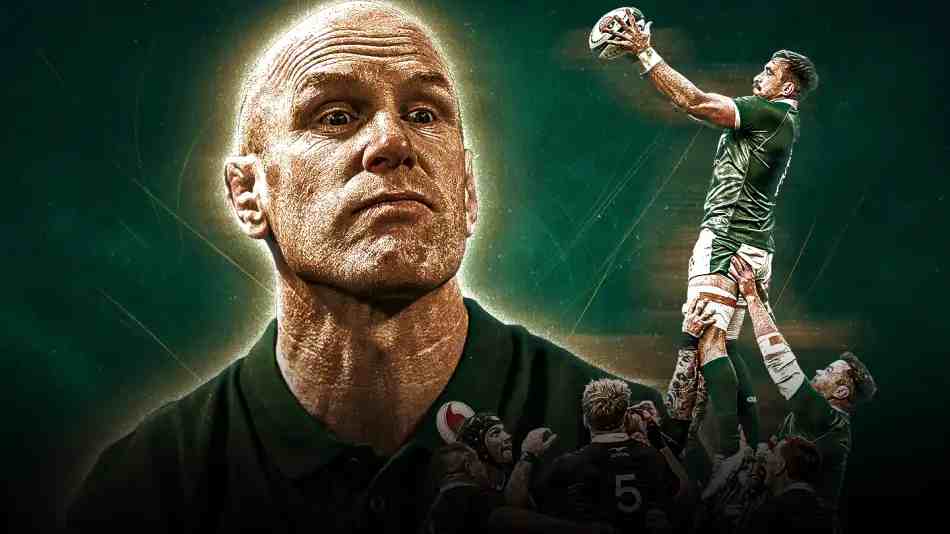
“I suppose people are only human,” Andy Farrell mused in Chicago on Saturday night, as he reflected on an Irish set-piece which is no longer reliable.
The Ireland head coach was, for the second year in succession, handed a brutal start to the November Test window – taking a pop at a battle-hardened New Zealand side in their first proper hit-out. Jack Conan and Caelan Doris were playing their first games of the season, Andrew Porter had played 62 minutes and captain Dan Sheehan only managed 35.
Whoever is negotiating fixtures for the IRFU needs a refresher in how the game is played. The World Cup pool draw follows the Autumn Nations Series and Ireland’s 26-13 loss at Soldier Field has given the All Blacks a two-point swing. That game will put a lot of money in the union’s coffers, but at what competitive cost? Ireland are now less than a ranking point ahead of England and fifth-placed France.
There were plenty of frustrations emanating from that third Irish loss in a row to New Zealand. Debates continue around the Tadhg Beirne 20-minute red card – copped only three minutes into the match – but the Munster captain was clumsy in tensing up, perched high, with definite run-threat Beauden Barrett zooming towards him. Referee Pierre Brousset was not interested in rewatching a couple of borderline Kiwi shots and the whole replay system was poorly managed.
We then had the clear and obvious evidence Ireland players were flagging as the game went on. Farrell insisted his side’s failings of the final 20 minutes, when they scored no points and conceded 19, were primarily down to “mental lapses”. That is exactly what happens when lungs are searing and muscles are weary.
Tackle completion of 86% (Garry Ringrose missed seven), two line breaks and a scrum that went sideways on a few New Zealand put-ins took their toll. It was an opportunity missed against an All Blacks side that often looked flat and lost Scott and Jordie Barrett to injuries.
An area of real concern, though, is the ongoing trouble at the lineout. Just 11 of 16 Irish throws were cleanly won for a 69% success rate. There was a similar issue last November when they had a completion rate of 70% against the ABs, in another losing cause. “The New Zealand defensive lineout has been top drawer for a long time now so that’s always going to be part of it,” said Farrell. “We need to look at ourselves first and foremost.”
Three of Ireland’s lineout losses came at key points and punctured momentum. Ireland lost their first lineout when there was a complete communication breakdown, 53 seconds in. Lifters, Porter and James Ryan, were preparing to launch Ryan Baird at the front when Sheehan squeezed the trigger. Baird never got off the ground, Tadhg Furlong was caught unawares and Codie Taylor snagged the bouncing ball.
On 22 minutes, there was nice Ireland deception and a Ryan take but Sheehan’s throw was not straight. When Baird stole a Taylor throw four minutes later, former Ireland hooker Bernard Jackman observed “both lineouts have been a mess”. Those sentiments were borne out when Taylor was pinged for another crooked throw, and Fabian Holland stole a Sheehan dart, all before half-time. Josh Lord picked Sheehan off in the second half and Baird snatched another from Taylor. The collective struggles went a long way to making the game such a tough watch. When Ireland did get a lineout right in the New Zealand red zone, it led, 25 seconds later, to Furlong’s try.
What makes Ireland’s woes all the more perplexing is the man in charge was one of the lineout greats during his days stalking the pitch. Paul O’Connell was obsessive about Ireland’s lineout and disrupting the opposition. He famously studied and learned Afrikaans in 2009 to help anticipate throws from John Smit and Bismarck du Plessis and has an illustrious list of admirers, including Victor Matfield and James Horwill.
O’Connell joined Farrell’s coaching set-up in January 2021. As forwards specialist, the former Munster and Ireland captain is tasked with multiple responsibilities. Getting the lineout purring is a vital undertaking, though. When compared against the other Six Nations and Rugby Championship sides, O’Connell got off to a decent start with the Irish lineout – they finished fifth overall in 2021 with an 86.6% success rate.
The following year was hugely positive for Ireland and it may not surprise you to learn a much-improved lineout was a key tenet. Sheehan had burst through to claim the starting hooker role. The Leinster man took 71% of all Ireland’s throws (117) and had a 92.3% success rate (108 won). Rob Herring and Rónan Kelleher were the steady deputies and Ireland ranked second overall, for leading Test nations, with lineout success of 91.1%. Beirne claimed the most takes (42) when Ryan (28) and Peter O’Mahony (26) next up.
From that high to the rock bottom of 2023. There were some anomalies here, with Ireland winning their first 13 games of the year, including a Six Nations Grand Slam. There was even Josh van der Flier drafted in as emergency thrower when Sheehan and Kelleher were injured against Scotland.
As it was a World Cup year, there was a larger spread of duties. Sheehan was down to taking just 36% of lineout throws (69), with Kelleher on 29%, Herring 26% and Tom Stewart 8%. As a collective, Ireland’s success rate was 84.2%. Both South Africa and New Zealand went after them at the World Cup as that platform for launch-plays was sullied. Ireland lost six lineouts against the Boks in Paris during their 13-8 win. O’Mahony (37) had the most takes but, curiously, Beirne was back in fourth (24).
2024 was not much better as Ireland finished seventh of those 10 nations with a lineout success rate of 86.1%. Kelleher is a less reliable thrower than Sheehan at Test level, and he took the majority of lineouts after his provincial teammate damaged knee ligaments on the South Africa tour. Both men had a tough evening in the first Test in Pretoria. Ireland lost four of their 14 lineouts, with four ‘wins’ being extremely scruffy and halting any progress.
At the time, former Leinster and Ireland hooker James Tracy told us “South Africa are clear in how they disrupt. It’s a common theme. It is so hard to get into your flow as they are so good at that disruption. They fly in as hard as they can, and cause a s**t-fight.”
Sure enough, the All Blacks took what the Boks did and made an even greater mess later that year. With Kelleher throwing, and Herring backing up, Ireland lost three of their 10 lineouts, with three more being severely disrupted. Matters improved slightly for wins over Argentina and Fiji, but Australia hunted a few Kelleher darts and were rewarded.
Beirne, with 35 successful catches, was Ireland’s top target in 2024 and, with O’Mahony playing fewer minutes, a new jumper emerged. Joe McCarthy (18 takes in 2024) was being groomed to step up his lineout involvements by O’Connell but injuries mean he has only started two Tests in green this year. McCarthy’s misfortune, allied with Sheehan’s knee injury and the retirement of O’Mahony, have all dented Ireland’s lineout prowess.
Baird has the most takes (28) this year, followed by Beirne (25), but there is a big drop-off after that. Next on the list is O’Mahony (10), who retired in May, followed by Ryan and Jack Conan (both nine). According to Opta, Ireland’s five- and six-man lineout units have dropped from 64% (combined) in 2021 to 39% in 2025. It makes it so easier for the opposition to make reads if only two players look realistic targets.
The stand-out figures from the O’Connell set-piece stewardship indicate increasing tendencies to throw to the front, and steer clear of the back. Here is how much the lineout lengths have changed since O’Connell took over.