

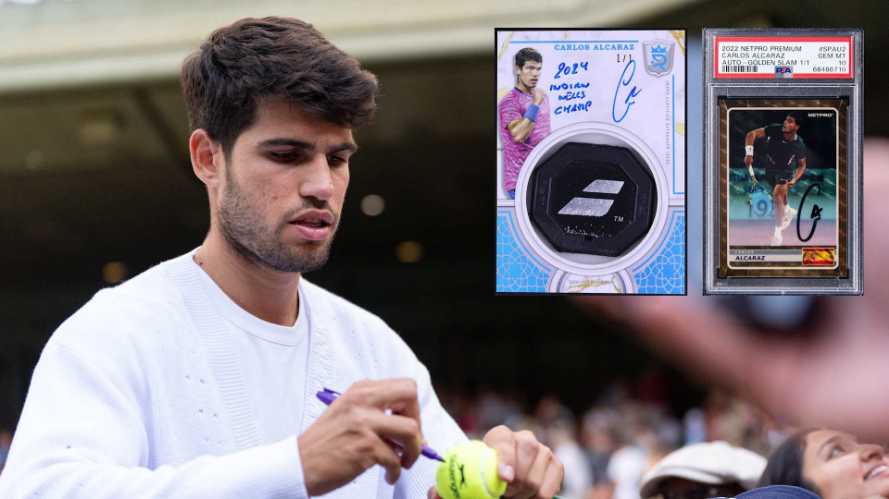
Go ahead, Nole fan. Pick up that trading card packed safely in its slim and durable transparent case. Note that it is from 2007, the year of your idol’s breakthrough, and that it depicts Djokovic lunging for a backhand—what would soon be celebrated as his trademark aggression.
Note, too, that the card is autographed by Novak himself. It’s certified authentic by PSA (Professional Sports Authenticator). And then there’s this: embedded in this card is a swatch of pale blue cloth, part of a shirt that Djokovic wore in combat. Like the religious article the presentation calls to mind, the swatch is called a “relic.”
This graded card, eBay tells you, can be yours for a mere $999.99 (or best offer).
Welcome to the world of sports cards, a hobby that has evolved from humble origins into a sophisticated, multi-billion dollar global enterprise which has spawned its own ecosystem, complete with hierarchical product lines and its own esoteric language—attributes that are appealing to the collector’s mentality, as well as ambrosia for profit hunters.
If you’re a Boomer, you may fondly remember the thrill of walking down to the corner candy store, allowance money jingling in your pockets, to purchase a wax pack of Topps baseball or football cards, containing stiff cardboard pictures and a bonus panel of deliciously scented pink bubble gum. These days, the only resemblance to that experience is the exquisite curiosity and hope you might feel as you tear open the wrapping (now shiny foil) covering for a pack of cards that came in a “blaster box.”
Eric Winston, the president of Winner’s Alliance—the Name, Image and Likeness licensor for cards produced by Topps (including tennis cards)—told me, “Topps and Fanatics aren’t just doing the old, ‘Hey, let’s put a picture on a piece of cardboard’ and give them a little bio and stats on the back. They’re really selling a story. They’re selling a piece of history. Some of the cards we used to collect as kids are becoming pieces of art.”
This is as good a time as any to pause and let the uninitiated know that the trading card industry is so terminology-driven that major players like Topps (owned by Fanatics, the sports business giant) publish tutorials and a glossary, in this case at the Topps Ripped website. There you can learn the meaning of words and terms like “Liquid Silver,” “Refractor,” “breaking,” “low numbers/low series,” “patch cards” and “slabbing.” They are becoming more vital, for better or worse, to today’s trading card experience.
The trading card industry came to tennis late, and in its mature phase. Although tennis cards have been offered by some operators for years (mainly NetPro and Ace Authentic), it wasn’t until 2021, when Fanatics/Topps jumped into the fray, that the number of players who signed up to be part of the program—now roughly 300—achieved critical mass to claim equal footing with sports that have a rich history in cards.
“This is kind of the first time it’s been done, like, ‘the right way,’” says Ryan Olli, the senior manager of licensing at Winner’s Alliance. “We were like, ‘Okay, we’re going to get a list of players that is 200, 300, whatever amount of players they want access to.’”