

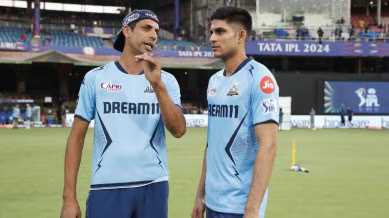
A support staff standing beside the boundary ropes having an animated discussion; head coach hurrying out to the middle as soon as the umpire points to a time-out; cryptic messages struck outside the dressing room or a paddle being raised to communicate a strategy to the captain or batsmen in the middle; bowling coaches jumping off their seat and hurrying to a bowler for a chat just after being taken for plenty. These are no longer rare visuals, but most frequent in the Indian Premier League.
IPL has ushered in the age of football managers into cricket.
“The pool of captains’ is small. The pool of coaches is bigger,” Mike Hesson who coached Punjab Kings and Royal Challengers Bengaluru in the past tells The Indian Express.
In a league that was once the battlefield of shrewd captains, it’s now beginning to incline towards a combat zone headed by master tacticians and strategists enlisting help from support staff to assist with data. With the franchises moving on from MS Dhoni, Rohit Sharma, Virat Kohli, Faf du Plessis as captains, the upcoming IPL will have just two captains (Hardik Pandya and Shreyas Iyer) who have had the experience of captaining a championship winning team. And incidentally both are now part of a different franchise, where they are out there to prove it again.
“I think a coach knows his life as well,” says Hesson. “If the team does well, it’s the players, and if the team doesn’t go well, it’s the coach. I mean, that’s the general philosophy and every coach enters knowing that. Every franchise has high expectations, and rightfully so, and you get a period of time to show whether you can turn a team around — whether that means turning them from last into play-off contention, or sustaining a winning culture and winning trophies. Every team is different in the IPL. But I think every franchise has a very high expectation of what the coach can bring,” Hesson says.
And so, IPL is fast moving from being captain-run to being coach-led. While the likes of Stephen Fleming and Mahela Jayawardene mostly restrict themselves to the background, Ashish Nehra, Chandrakant Pandit, Andy Flower, Ricky Ponting, Justin Langer with their animated gestures and signals from the dug-out or near the boundary ropes can easily remind you of Pep Guardiola, Carlo Ancelotti or Mikel Arteta.
While Hesson agrees that the influence of coaches has increased, he prefers striking a balance. “I think that the one beauty you have from the dugout is you can see a completely different perspective. So, I think as long as the coach doesn’t think that he knows best, its fine. A big part of the coach’s job is to work with the players outside of the game so that they’re confident and prepared in their decision making. I think the last thing you want to do is be trying to captain by remote control. I think that really undermines the captain. So, I think there really is a balance,” Hesson says.
In that regard the IPL seems far different to a national team culture where in recent years players have turned their back on coaches who have come across as the command centre.
Dan Weston, who offers strategic services to T20 teams and is currently associated with Birmingham Phoenix in The Hundred, believes coaches need to take more decision making power.
“I think that they’ve sometimes been reluctant to do that. There’s definitely a culture sometimes where players want to do it their own way and coaches can be kind of laid back about that. But I do think that there’s a balance to be had between letting the players run the show and actually having, having a coach who’s very strong tactically. You got to have a strong tactical coach, definitely,” Weston tells this newspaper.