

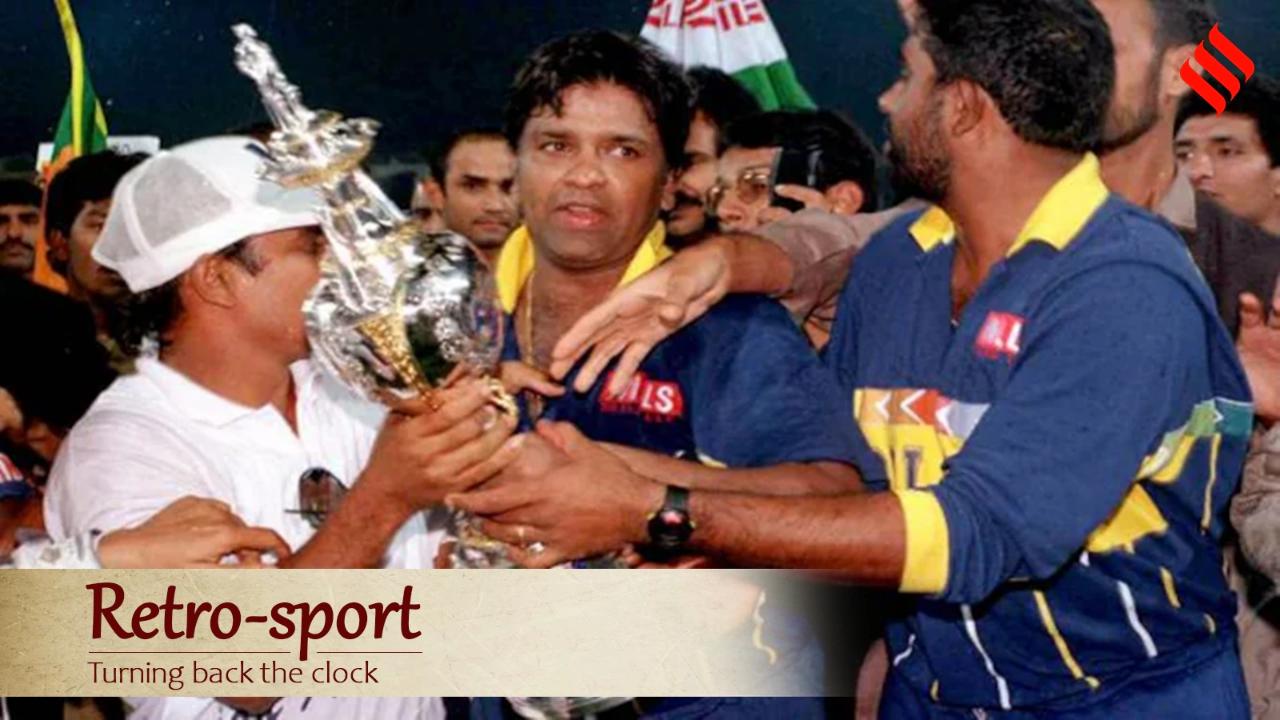
The recently-concluded 2026 T20 World Cup was noteworthy for the kind of performances that countries that were deemed underdogs put in. Sri Lanka in 1996 may have been a Test-playing nation for 14 years but were yet to be taken as serious contenders in the World Cup. The fact that they reached the final itself was seen as an achievement but it was almost exactly what their pugnacious captain, the legendary Arjuna Ranatunga, had wished for earlier in the tournament, right down to who they would face once they get there.
Australia had refused to play a match in Colombo earlier in the tournament due to security concerns after which Ranatunga had said: “We want the Australians in the final.” He got exactly that and then, when he won the toss on March 17, 1996, Ranatunga bowled first, hoping that his pacers get some early wickets in the cool conditions at the Gaddafi Stadium in Lahore. It was the first day-night match to be played in Pakistan.
In the opening exchanges, it had looked like the match would go as was expected. Mark Waugh fell early to Chaminda Vaas but his opening partner and captain Mark Taylor and Ricky Ponting blazed 72 runs in the first 13 overs. Ranatunga’s plan of getting some early wickets via pace, had failed. But as it turned out, that was the only period in which Australia looked clearly on top of the game. Ranatunga brought in his spinners, Muttiah Muralitharan and Aravinda de Silva and later mixed in Kumar Dharmasena and Sanath Jayasuriya. Muralitharan may have gone on to be recognised among the greatest bowlers of all time but this was to be Aravinda’s day all the way.
He first dismissed Taylor on 74 off 83 balls and then Ponting on 45 off 73. De Silva later went on to dismiss Ian Healy and finished the Australian innings with figures of 3/42. Jayasuriya, Dharmasena and Muralidaran all finished with a wicket each and Australia had compiled a score of 241/7 in their 50 overs.
Sanath Jayasuriya and Romesh Kaluwitharana’s approach to opening the batting in this tournament has in the years since come to be recognised as a significant milestone in the history of the sport. Gone were the days when openers would blunt the early salvo from the bowling side, Jayasuriya and Kaluwitharana made full use of the 15-over fielding restrictions that had been introduced in 1996 and made it a policy to smash the living daylights off the white ball in the early overs. Interestingly, though, the pair fell flat on the final, the biggest game of them all. Jayasuriya was ran out by the barest of margins while Kaluwitharana was caught at square leg off Damien Fleming.
From there, though, it was all Sri Lanka with Australia being guilty of some very un-Australian fielding lapses. This was the first day-night match in Pakistan and the effect of dew may have been a factor, something that cricketers at the time weren’t too used to dealing with. The Australians kept fumbling the ball and dropped four catches that came to them for the rest of the evening.
The Sri Lankans made full use of it. De Silva had led the way with the ball, he now led with the bat, first with a strong stand with Asanka Gurusinha (65 off 99 balls) and then with an unbeaten one with captain Ranatunga (47 off 37). De Silva, meanwhile, finished with 107 off 124 balls. He was just the third player to score a century in a men’s World Cup final after West Indies greats Clive Lloyd and Viv Richards.
The victory started a period in which Sri Lanka, while not dominant, were always among the tougher teams in the world to beat. They would go on reach the finals in back-to-back World Cups in 2007 and 2011 but ended on the wrong side of the result on both occassions. It was Australia led by Ricky Ponting who beat them in the 2007 final by 53 runs and in 2011, they were beaten by MS Dhoni’s India. Since 2014, however, Sri Lanka haven’t quite managed to maintain those lofty standards.
Australia, on the other hand, would go on to reach the final of the next three World Cups as well – and they won the title on occassion. The 2011 title clash between India and Sri Lanka was the first in nearly two decades to not feature Australia. However, they were back in 2015 to win their fifth title and they then beat the much favoured Indian side in 2023 to lift the World Cup a sixth time.